
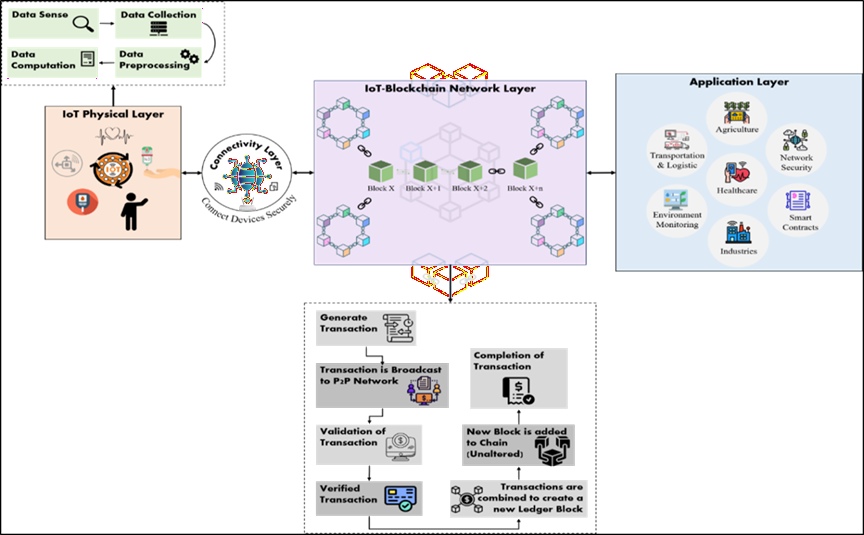
With the rapid growth of digital technologies, healthcare systems are becoming smarter and more connected. The integration of Internet of Things (IoT) devices has enabled real-time monitoring of patients, improving diagnosis and treatment. However, this advancement also introduces serious challenges related to data security, privacy, and trust.
Traditional centralized systems are vulnerable to data breaches, unauthorized access, and single points of failure. To address these challenges, a powerful combination of Blockchain, IoT, and Machine Learning is emerging as a next-generation solution for secure healthcare systems.
Understanding IoT in Healthcare
The Internet of Things (IoT) connects physical devices such as sensors, wearables, and medical equipment to collect and exchange data.
In healthcare, IoT enables:
- Continuous patient monitoring
- Real-time health data collection
- Remote diagnosis and treatment
For example, devices can track:
- Blood glucose levels
- Heart rate
- Blood pressure
This data helps doctors make faster and more accurate decisions.
Security Challenges in IoT Systems
Despite its benefits, IoT-based healthcare systems face several critical issues:
- Data Breaches: Sensitive patient data can be exposed
- Lack of Privacy: Centralized storage makes data vulnerable
- Single Point of Failure: One attack can compromise the entire system
- Unauthorized Access: Weak authentication mechanisms
These challenges make it essential to adopt a more secure and decentralized approach.
Role of Blockchain in Securing IoT
Blockchain technology provides a decentralized and tamper-proof system for storing and sharing data.
Key Features:
- Decentralization: No central authority controls data
- Immutability: Data cannot be altered once stored
- Encryption: Strong cryptographic security
- Transparency: All transactions are verifiable
In healthcare, blockchain ensures:
- Secure storage of patient records
- Safe data sharing between doctors and hospitals
- Protection against data tampering
Integration with Machine Learning
Machine Learning enhances the system by analyzing large volumes of health data.
Applications:
- Disease prediction (e.g., diabetes detection)
- Pattern recognition in patient data
- Personalized treatment recommendations
In this research, multiple algorithms such as:
- Decision Tree
- Random Forest
- Support Vector Machine (SVM)
- K-Nearest Neighbors (KNN)
were used, with Decision Tree and AdaBoost showing the best performance in diabetes prediction.
Proposed Smart Healthcare Framework
The research proposes a 5-layer architecture for secure patient monitoring:
1. IoT Sensor Layer
Collects real-time health data from patients
2. Blockchain Layer
Ensures secure and tamper-proof data storage
3. Machine Learning Layer
Analyzes data for disease prediction
4. DApp Layer
Allows interaction between users through decentralized applications
5. Doctor–Patient–Hospital Layer
Facilitates communication and decision-making
Key Contributions of the Research
- Developed a secure blockchain-based healthcare framework
- Enabled real-time remote patient monitoring
- Improved data privacy and integrity
- Reduced gas consumption in smart contracts
- Enhanced accuracy in diabetes prediction using ML models
Why This Research Matters
This work provides a scalable and secure solution for modern healthcare challenges by:
- Eliminating centralized vulnerabilities
- Ensuring patient data privacy
- Supporting real-time medical decisions
- Enabling remote healthcare services
It is especially useful in situations like:
- Rural healthcare access
- Pandemic scenarios
- Chronic disease management
Future Scope
Future improvements can include:
- Integration with advanced AI models
- Expansion to other diseases beyond diabetes
- Improved scalability for large healthcare networks
- Enhanced interoperability across systems
Conclusion
The integration of IoT, Blockchain, and Machine Learning represents a transformative approach to modern healthcare. By addressing critical issues like security, privacy, and efficiency, this framework offers a reliable solution for smart and secure patient monitoring systems.
This research not only contributes to academic advancement but also has strong potential for real-world healthcare applications.