
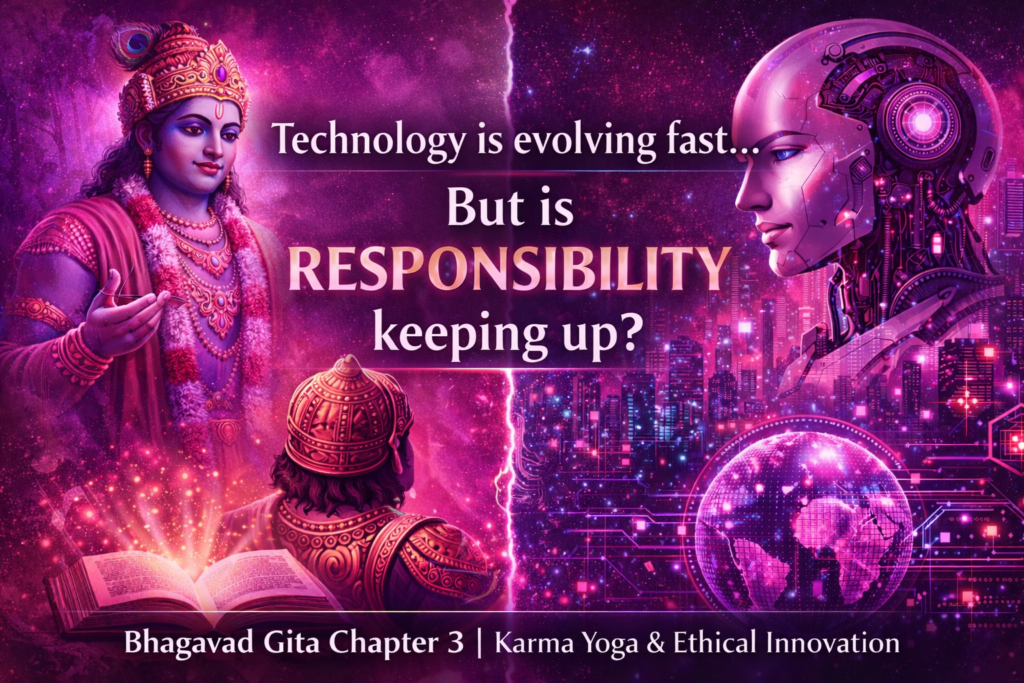
We are living in an era where technology is moving faster than human reflection.
Artificial Intelligence is transforming decisions. Automation is reshaping industries. Algorithms influence what people see, think, and trust. Every day, innovation is becoming faster, smarter, and more powerful.
But amid all this progress, one question becomes impossible to ignore:
Are we innovating responsibly, or are we simply innovating rapidly?
This question lies at the heart of one of the most practical teachings in the Bhagavad Gita.
In Chapter 3, Karma Yoga, Lord Krishna teaches Arjuna that action is necessary, but action must be guided by responsibility and purpose.
This ancient teaching carries a message that feels remarkably relevant in the modern technological world.
Because today, the biggest challenge in technology is not the lack of innovation.
The real challenge is the lack of responsible innovation.
The world celebrates speed.
Companies compete to launch faster products.
Developers race to build smarter systems.
Organizations push for automation, scale, and digital dominance.
But in this race, one essential question is often ignored:
What is the purpose behind the technology we create?
This is exactly where Karma Yoga becomes meaningful.
Krishna explains that actions performed without responsibility or ethical purpose create imbalance.
This truth applies directly to technology.
Artificial Intelligence can improve efficiency, but without responsibility, it can amplify bias.
Automation can boost productivity, but without ethical planning, it can increase unemployment.
Data systems can personalize services, but without safeguards, they can threaten privacy.
Digital platforms can connect people, but without accountability, they can spread misinformation.
These are not failures of innovation.
They are failures of responsibility.
This is why Chapter 3 of the Bhagavad Gita feels so important today.
Because Karma Yoga teaches that action alone is not enough.
The value of action depends on the intention behind it.
In the digital age, innovation is often driven by:
- competition
- profit
- speed
- market control
But Karma Yoga teaches that meaningful action should be driven by:
- responsibility
- service
- balance
- long-term welfare
This is the ethical gap in modern technology.
We are building systems that are technically advanced, but not always socially responsible.
And that gap is creating some of the biggest problems in the digital world:
- biased AI decisions
- privacy violations
- digital exploitation
- social manipulation
- growing mistrust of technology
These issues exist because innovation is often pursued without enough ethical responsibility.
This is the modern relevance of Karma Yoga.
Krishna’s message is simple but powerful:
Action performed with responsibility creates harmony.
Action driven by selfish desire creates harm.
This principle applies directly to the technologies shaping our future.
Every algorithm affects human lives.
Every platform influences behaviour.
Every automated system creates consequences.
Technology is not neutral—it reflects the values of those who create it.
That is why responsible action matters more than speed.
The digital world often rewards those who move first.
But Karma Yoga reminds us that moving first is not the same as moving wisely.
Before building powerful technologies, innovators must ask:
- Will this benefit society?
- Could this create harm?
- Is this ethically designed?
- Are we acting responsibly?
These are not technical questions.
They are moral questions.
And that is why the wisdom of Chapter 3 is so relevant.
The future of technology will not be defined only by intelligence.
It will be defined by responsibility.
Because the most advanced technology can still create harm if it lacks an ethical purpose.
But when innovation is guided by responsibility, it becomes a force for positive transformation.
This is the true message of Karma Yoga in the digital era.
Technology needs more than speed.
It needs purpose.
It needs ethical responsibility.
It needs human values.
Because the future will not depend only on how powerful our technologies become-
It will depend on the responsibility with which we choose to build them.
This is why Chapter 3 of the Bhagavad Gita offers a timeless lesson for the modern world.
In a time where innovation moves rapidly, Karma Yoga reminds us that true progress is not measured by speed—
True progress is measured by responsible action.
And perhaps this is the lesson technology needs most today:
Innovation without responsibility creates risk,
but innovation guided by responsibility creates a better future.
That is the timeless wisdom of Chapter 3, and it may be one of the most important lessons for the future of technology.
Pingback: Why Do We Have Everything Yet Still Feel Empty? Bhagavad Gita Chapter 9 Explained for the Digital Age