Technology has transformed nearly every part of human life.
It shapes how people communicate, how they work, how they learn, and even how they think. Smartphones, artificial intelligence, social media, and constant internet access have created a world where information moves instantly and attention is always in demand.
These innovations have brought extraordinary convenience, but they have also introduced new problems. Many people today struggle with digital overload, reduced attention spans, constant distraction, and mental fatigue caused by the endless demand for engagement.
This is where the teachings of Bodhidharma become surprisingly relevant.
Although Bodhidharma lived centuries ago, the principles he emphasized—awareness, discipline, and inner clarity-offer valuable guidance for modern life in an age dominated by technology.
His teachings were rooted in the idea that the human mind must be trained to remain clear and focused. In today’s digital environment, that message may be more important than ever.
The Digital Age Has Increased Convenience but Reduced Attention
Modern technology has made life easier in countless ways.
People can access information instantly, connect globally, automate tasks, and solve problems faster than at any other point in history. Businesses operate more efficiently, education is more accessible, and communication happens in real time.
But while technology has improved convenience, it has also created a serious challenge: the constant fragmentation of human attention.
Notifications interrupt work. Social media competes for focus. Algorithms are designed to keep users engaged for as long as possible. As a result, many people spend large parts of their day reacting to digital prompts rather than acting intentionally.
This constant stimulation weakens concentration.
Research in digital behavior has repeatedly shown that frequent interruptions reduce productivity, increase cognitive fatigue, and make deep focus more difficult to maintain.
In practical terms, technology often controls attention rather than serving it.
This is exactly where the teachings of Bodhidharma provide an important perspective.
Bodhidharma’s Teaching of Awareness Matters More Than Ever
At the center of Bodhidharma’s philosophy was awareness.
He taught that true clarity comes from observing the mind—becoming aware of thoughts, impulses, habits, and reactions instead of being controlled by them.
This teaching is deeply relevant to modern digital life.
Every notification, alert, and recommendation on digital platforms is designed to trigger an immediate reaction. Without awareness, people respond automatically. They open apps without intention, scroll without purpose, and spend time in ways they never consciously planned.
Awareness interrupts this cycle.
It creates the space to ask simple but important questions:
- Why am I opening this app right now?
- Is this helping me or distracting me?
- Am I acting intentionally or automatically?
These questions restore conscious choice.
That is one of the most valuable skills in the digital age.
Technology becomes healthier when it is used intentionally rather than habitually.
Discipline Is the Missing Skill in a Hyperconnected World
Another important principle in Bodhidharma’s teaching is discipline.
Discipline was not simply about rules it was about training attention.
In modern life, attention is under constant pressure. Social platforms, entertainment systems, and mobile apps are built to compete for as much time and engagement as possible.
This creates a culture of distraction where sustained focus becomes rare.
The result is visible everywhere:
- reduced concentration
- mental exhaustion
- lower productivity
- increased anxiety
In this environment, discipline becomes essential.
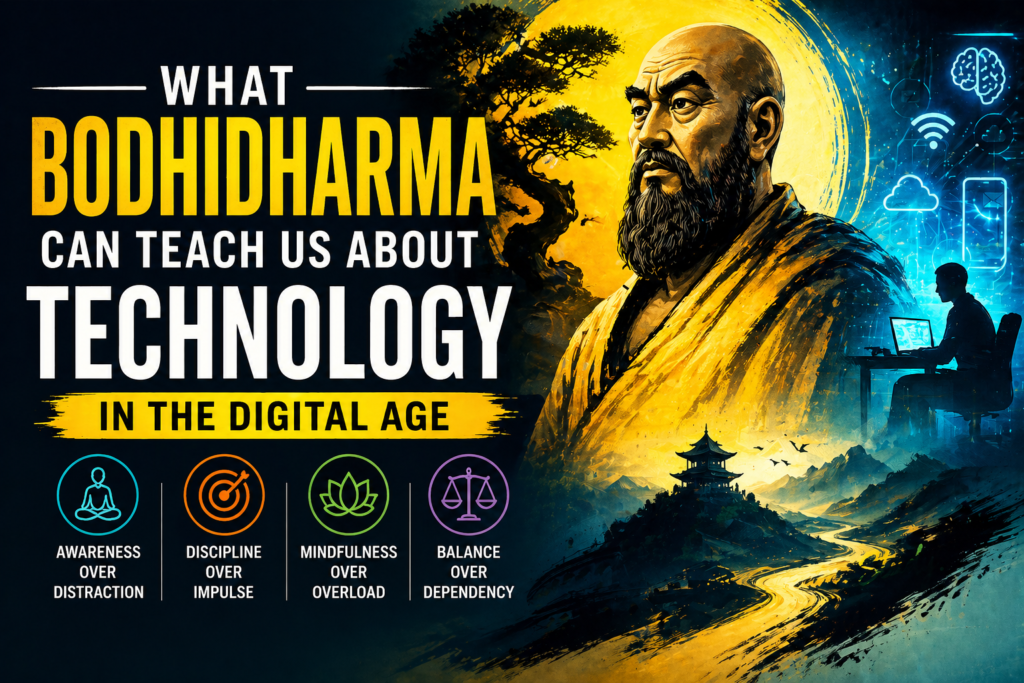
The discipline that Bodhidharma taught can be applied today through practical habits:
- limiting notifications
- creating focused work periods
- reducing unnecessary screen time
- using technology with purpose
These habits protect attention.
And in a world where attention is constantly targeted, protecting attention is a form of freedom.
Technology Should Support Life, Not Control It
One of the greatest dangers of modern technology is that people begin to serve the system rather than using the system as a tool.
Many digital platforms are designed to maximize engagement, not well-being.
That means users can easily become trapped in patterns of endless scrolling, constant checking, and digital dependency.
The teachings of Bodhidharma challenge this pattern by reminding people to return to conscious awareness.
The goal is not to reject technology.
The goal is to prevent unconscious dependence on it.
Technology is valuable when it supports:
- learning
- communication
- productivity
- creativity
But when it consumes attention without purpose, it begins to control behavior.
The wisdom of Bodhidharma reminds us that human awareness must remain stronger than digital influence.
That idea is increasingly important in a world shaped by algorithms.
Ancient Wisdom Can Improve Modern Technology Use
The modern world often treats technology as the solution to every problem.
But technology alone cannot create balance.
No matter how advanced digital systems become, human well-being still depends on:
- clarity
- awareness
- discipline
- intentional action
These are the very qualities emphasized in the teachings of Bodhidharma.
His wisdom reminds us that external progress must be matched by internal awareness.
Without that balance, convenience can become dependence.
With that balance, technology becomes a tool for growth.
This is why ancient teachings still matter in modern life.
They provide the inner discipline needed to use powerful tools wisely.
Final Thoughts
The digital age has given humanity extraordinary technological power.
But it has also created unprecedented competition for human attention.
In such an environment, the teachings of Bodhidharma offer timeless value.
His message was simple but powerful:
Develop awareness. Protect attention. Live consciously.
These principles were once taught in spiritual practice, but today they may be essential for healthy technology use.
Because the real challenge of the digital age is not technology itself.
The real challenge is whether people can remain conscious while using it.
That is where the wisdom of Bodhidharma continues to matter.
And that may be one of the most important lessons modern life can learn from ancient thought.