We live in a world overflowing with information.
Artificial Intelligence can generate answers in seconds. Search engines provide instant access to knowledge. Algorithms process enormous amounts of data faster than any human mind ever could.
Technology has made information limitless.
Yet despite all this advancement, one fundamental question remains:
Does having more information mean we have more wisdom?
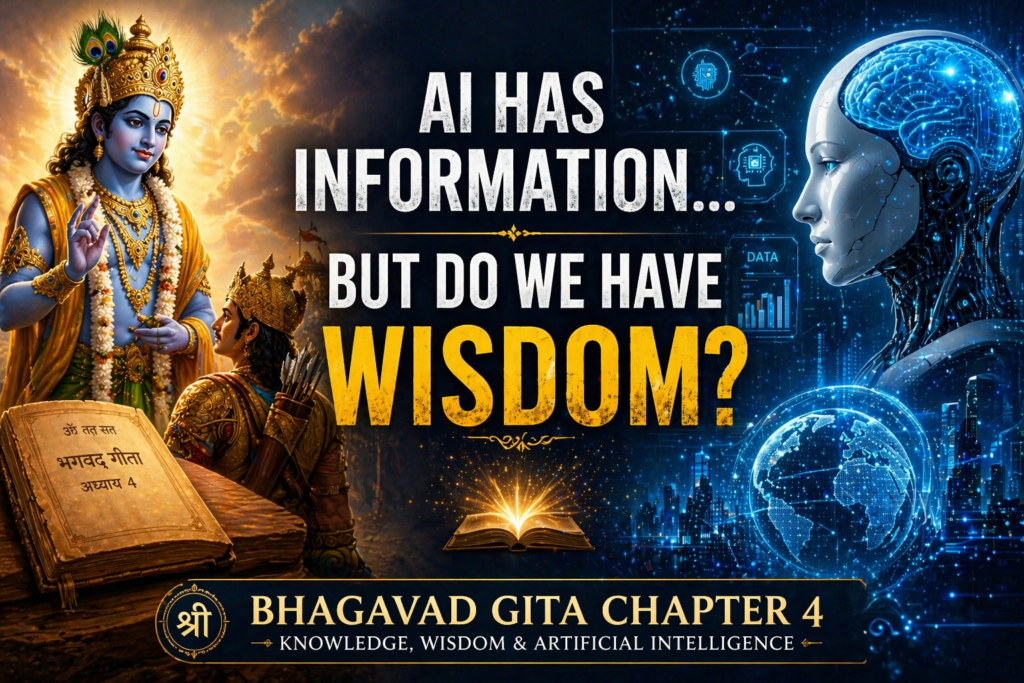
This question is at the heart of Chapter 4 of the Bhagavad Gita, known as Jnana Karma Sanyasa Yoga, the Yoga of Knowledge and Wise Action.
In this chapter, Lord Krishna explains that true knowledge is not mere information it is wisdom that guides right action.
This ancient insight is deeply relevant in today’s age of Artificial Intelligence and digital transformation.
Because modern technology gives us unprecedented access to information, but information alone cannot solve human problems.
Data is everywhere.
Machines can learn patterns.
Algorithms can predict behavior.
AI can automate decisions.
But none of these guarantees understanding.
This is where the wisdom of Chapter 4 becomes powerful.
Krishna teaches that knowledge has value only when it leads to understanding, responsibility, and purposeful action.
That message speaks directly to the modern digital world.
Today, businesses, institutions, and individuals often equate information with intelligence.
The assumption is simple:
More data = better decisions.
But this is not always true.
Without understanding, information can create confusion.
Without ethics, intelligence can create harm.
Without wisdom, innovation can lose its purpose.
This is exactly what we are witnessing in the modern technological era.
Artificial Intelligence processes information faster than ever before.
But without human wisdom, AI can:
- spread misinformation
- amplify bias
- invade privacy
- automate harmful decisions
- create dependency on machines
These are not failures of technology.
They are failures in the way knowledge is understood and applied.
This is why Chapter 4 of the Bhagavad Gita is so relevant today.
Jnana Karma Sanyasa Yoga teaches that true knowledge transforms action.
It is not enough to possess information.
What matters is the wisdom to use that information responsibly.
This is one of the greatest challenges in the age of Artificial Intelligence.
We are surrounded by more information than any generation in history.
Yet the world still struggles with:
- unethical technology
- misinformation
- digital manipulation
- irresponsible automation
- lack of trust in AI systems
Why?
Because information is increasing faster than wisdom.
Technology is making knowledge accessible, but it cannot guarantee ethical understanding.
This is where Krishna’s teaching becomes timeless.
He explains that knowledge should lead to awareness, and awareness should guide action.
In the context of modern innovation, this means:
Technology must be guided by wisdom, not just by data.
This principle is essential for the future of AI.
Because the greatest danger in the digital era is not lack of information—
The greatest danger is having immense information without the wisdom to use it well.
This is the crisis of the modern knowledge economy.
Companies collect massive amounts of data.
AI systems generate insights instantly.
Digital platforms distribute information globally.
But without ethical understanding, these systems can create more harm than progress.
That is why Chapter 4 offers such a valuable lesson.
It teaches that true knowledge is sacred because it illuminates right action.
Applied to technology, this means innovation should not be driven only by efficiency or intelligence.
It should be guided by:
- wisdom
- ethics
- responsibility
- purpose
Only then can technology serve humanity meaningfully.
This is the real difference between information and knowledge.
Information fills systems.
Knowledge guides humanity.
And in the age of AI, that difference matters more than ever.
Because the future of technology will not depend only on how much information machines can process—
It will depend on how wisely humans use the knowledge they gain.
This is the timeless wisdom of Chapter 4 of the Bhagavad Gita.
As the world enters deeper into Artificial Intelligence, automation, and data-driven innovation, Krishna’s teaching reminds us that information alone is not enough.
True progress happens only when knowledge is joined with wisdom.
Because:
Information creates power,
but wisdom gives that power direction.
And perhaps this is the greatest lesson for the digital age:
In a world filled with information, true progress depends on wisdom.
That is why the message of Jnana Karma Sanyasa Yoga may be one of the most important teachings for the future of technology.