The world is becoming faster, smarter, and more automated.
Artificial Intelligence is changing the way we work, think, and interact. Machines are making decisions, algorithms are shaping choices, and digital systems are becoming part of everyday life.
Technology is advancing rapidly.
But as machines become more intelligent, an important human question emerges:
Are we becoming more balanced as technology becomes more powerful?
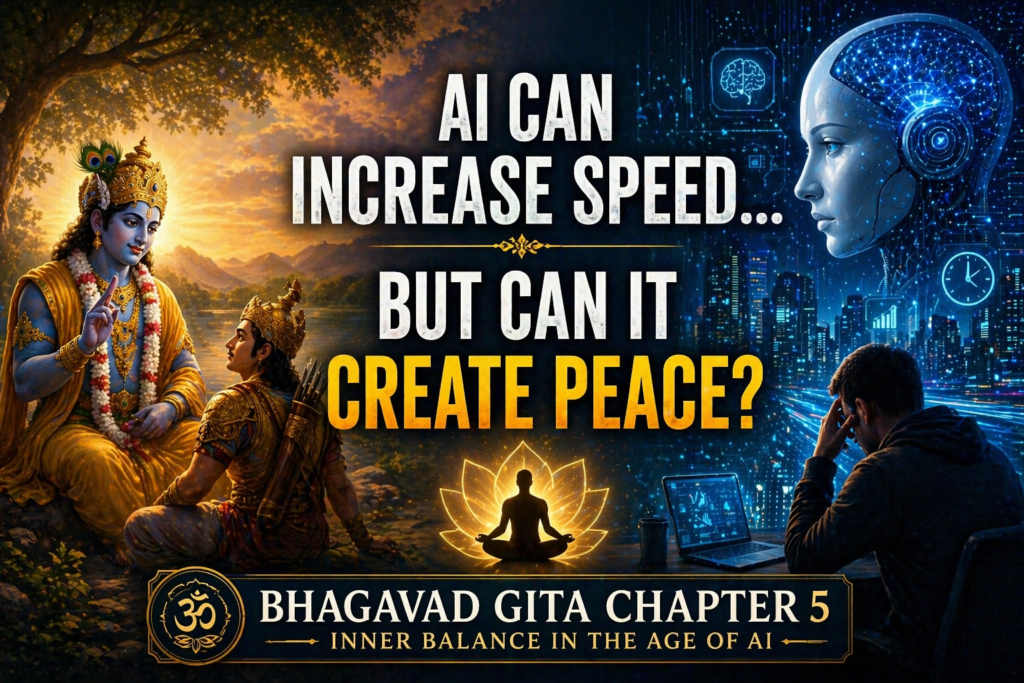
This question reflects the timeless wisdom of Chapter 5 of the Bhagavad Gita, Karma Sanyasa Yoga, the Yoga of Renunciation and Inner Peace.
In this chapter, Lord Krishna teaches that true progress is not found in external action alone-it is found in inner balance, clarity, and freedom from restless attachment.
This teaching is deeply relevant in today’s age of Artificial Intelligence.
Because while technology is accelerating outward progress, humanity is struggling with inner imbalance.
We are more connected than ever, yet more distracted.
We are more informed than ever, yet often less peaceful.
We are more productive than ever, yet increasingly overwhelmed.
This is the paradox of the digital age.
Technology gives speed.
But it does not give peace.
Artificial Intelligence can improve efficiency, but it cannot create emotional balance.
Automation can save time, but it cannot remove inner restlessness.
Machines can optimize tasks, but they cannot teach human beings how to live with clarity.
This is where Bhagavad Gita Chapter 5 becomes profoundly meaningful.
Krishna teaches that lasting peace comes when action is guided by balance rather than attachment.
This principle applies directly to modern technology.
Today, innovation is often driven by:
- urgency
- competition
- constant engagement
- endless productivity
This creates a culture where people are always connected but rarely calm.
Digital systems demand attention.
Notifications create anxiety.
Algorithms encourage constant stimulation.
The result is a world that is technologically advanced but emotionally exhausted.
This is the hidden cost of rapid innovation.
And this is exactly why the message of Chapter 5 of the Bhagavad Gita matters today.
Because inner stability is becoming as important as external progress.
Without balance:
- productivity becomes pressure
- connectivity becomes dependency
- speed becomes stress
- Innovation becomes overload
This is what Krishna’s teaching warns us about.
He reminds us that true freedom is not found in constant activity, but in the ability to remain centered while acting.
In the age of Artificial Intelligence, this means technology must support human well-being rather than dominate human attention.
Because the future should not be defined only by smarter machines—
It should also be defined by healthier human lives.
This is the real lesson of Chapter 5.
Innovation without balance creates burnout.
Progress without peace creates emptiness.
Efficiency without well-being creates exhaustion.
That is why inner balance matters.
As the world becomes increasingly automated, humanity must protect the qualities machines cannot replace:
- peace
- awareness
- emotional balance
- inner clarity
These are the foundations of meaningful progress.
Because no matter how advanced Artificial Intelligence becomes, human well-being remains the true measure of progress.
This is the wisdom of Karma Sanyasa Yoga.
Krishna teaches that peace comes not from controlling the outer world, but from mastering the inner one.
And perhaps that is the lesson technology needs most today.
Because:
A world with smarter machines but restless minds is not true progress.
True progress happens when innovation improves life without destroying inner balance.
That is why Bhagavad Gita Chapter 5 offers an essential message for the future:
Technology should increase human well-being, not reduce it.
As Artificial Intelligence continues to shape the future, the timeless wisdom of the Bhagavad Gita reminds us:
The goal of innovation is not only efficiency—
the goal is a better human life.
And that is why inner peace may be the most important human skill in the age of AI.