The digital age has given humanity extraordinary tools.
Artificial Intelligence can recommend what we watch, predict what we buy, guide what we read, and even shape how long we stay engaged with digital platforms. From social media feeds to intelligent assistants, modern technology is becoming increasingly capable of understanding human behaviour.
This has made life faster, smarter, and more convenient. But it has also created a deeper challenge. As technology becomes better at capturing our attention, many people are finding it harder to maintain focus, mental clarity, and inner calm.
This raises an important question:
If Artificial Intelligence is learning how to guide our attention, are we learning how to guide our own minds?
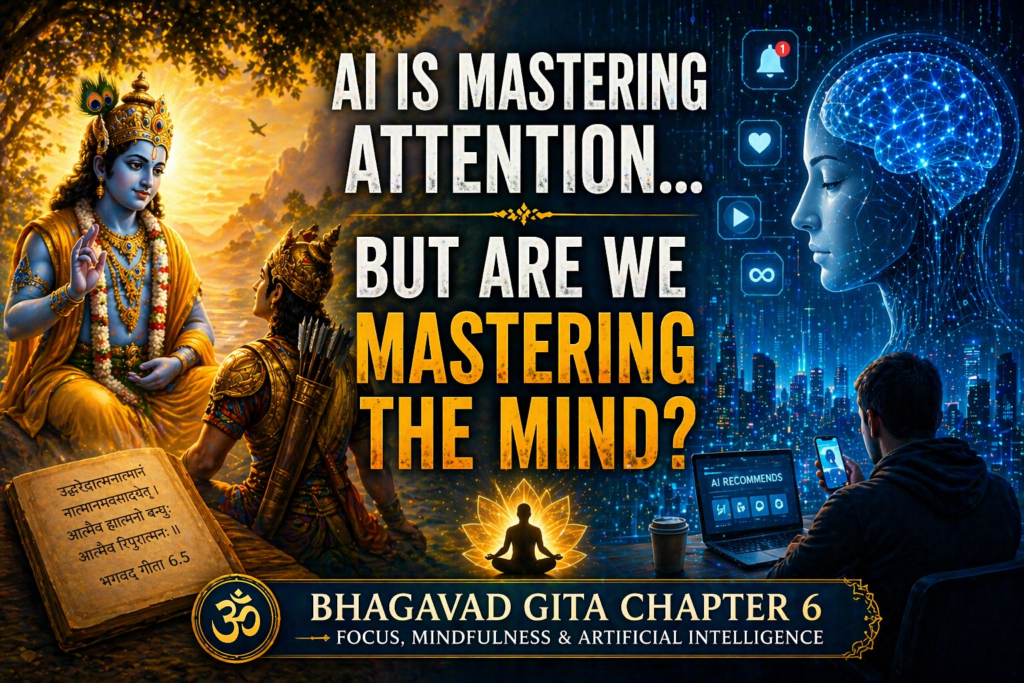
This question connects deeply with the message of Chapter 6 of the Bhagavad Gita, known as Dhyana Yoga, the Yoga of Meditation and Self-Control.
In this chapter, Lord Krishna explains that the mind has great power.
If disciplined, it becomes a source of strength.
If uncontrolled, it becomes a source of distraction and struggle.
This teaching has remarkable relevance in today’s AI-driven world.
Because one of the biggest challenges of modern technology is not simply the growth of Artificial Intelligence—
It is the growing struggle for human attention.
Artificial Intelligence systems are designed to learn patterns of behaviour. They study preferences. They predict reactions. They personalize content. These capabilities help improve user experience and make digital systems more efficient. However, these same systems are also designed to keep people engaged for longer periods.
This creates a world of constant stimulation:
- endless scrolling
- instant notifications
- personalized recommendations
- algorithm-driven content
As a result, people often experience:
- reduced focus
- mental fatigue
- distraction
- digital dependency
This is where Bhagavad Gita Chapter 6 becomes profoundly meaningful.
In Dhyana Yoga, Krishna teaches that mastering the mind is essential for living with clarity and peace.
He explains that an uncontrolled mind can pull a person in many directions, making peace difficult to attain. This description mirrors the modern digital experience. Today, countless digital systems compete for human attention. Algorithms are built to attract the mind. Notifications interrupt concentration. Digital environments are designed to keep people engaged.
This makes mental discipline more important than ever.
The wisdom of Chapter 6 of the Bhagavad Gita reminds us that the mind should not be controlled by external influences. Instead, it should be guided consciously. This teaching is highly relevant to Artificial Intelligence. AI can personalize digital experiences, but it should not replace human awareness. Technology can assist attention, but it should not dominate attention.
This is one of the key ethical concerns of the digital era.
As intelligent systems become better at influencing human choices, people need stronger self-awareness to maintain balance.
Without mental discipline:
- Convenience becomes dependency
- stimulation becomes distraction
- Personalization becomes manipulation
These are not merely technical concerns.
They are human concerns.
This is why the teaching of Dhyana Yoga feels so authentic today. Krishna teaches that self-mastery is the foundation of freedom. This idea is critically important in the AI era. Because in a world where algorithms are increasingly designed to influence behaviour, the ability to control one’s own mind becomes a form of independence.
This means that mental discipline is not just a spiritual practice-it is becoming a practical necessity. The relevance of this teaching becomes clearer when we consider how much time people spend responding to digital stimuli. Many struggle to remain present. Many find it difficult to focus deeply.
Many feel mentally overwhelmed despite using technologies designed to improve efficiency.
This is the paradox of the digital age.
Technology increases convenience, but it can reduce attentiveness. Artificial Intelligence improves efficiency, but it can increase distraction. That is why Bhagavad Gita Chapter 6 offers such valuable insight.
Its message is simple yet powerful:
The mind must remain stronger than the systems designed to influence it.
This is the true connection between Dhyana Yoga and Artificial Intelligence.
As technology becomes more intelligent, humans must become more mindful.
As algorithms become more advanced, individuals must become more disciplined.
As machines become more capable of directing attention, people must become more capable of protecting it.
This is the balance modern society needs.
The future of technology should not only be about smarter machines.
It should also be about stronger minds.
Because:
The greatest challenge of the AI age is not whether machines will become intelligent—
it is whether humans will remain mentally free.
This is the timeless wisdom of Chapter 6 of the Bhagavad Gita.
It reminds us that external progress must be matched by inner discipline. Without self-control, technology can overwhelm the mind. With mindfulness, technology can serve human well-being. That is why the lesson of Dhyana Yoga is so important in the modern world.
In the age of Artificial Intelligence, one truth becomes increasingly clear:
The future belongs not only to intelligent machines,
but to disciplined and mindful human beings.
And that may be one of the most authentic lessons Bhagavad Gita Chapter 6 offers for the future of technology.