We live in a world where comparison has become almost unavoidable.
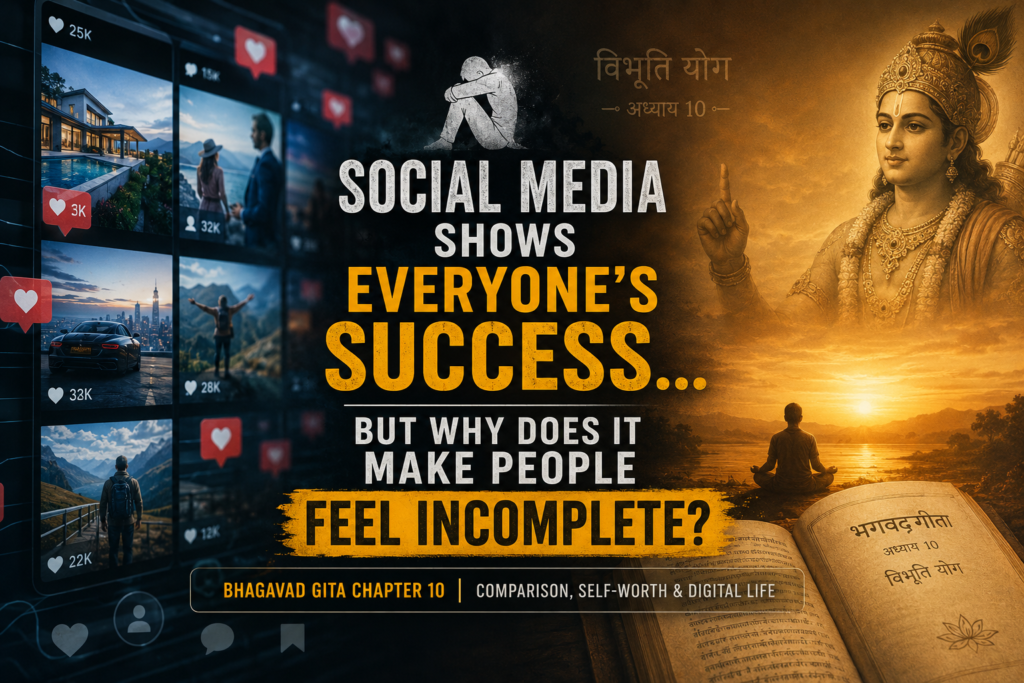
Every day, people open social media and instantly see:
- someone travelling
- someone succeeding
- someone getting promoted
- someone buying a new car
- someone living what appears to be a perfect life
Slowly, without realizing it, many people begin comparing their own lives with what they see online.
This creates a silent emotional pressure.
People start feeling:
- behind in life
- less successful
- less attractive
- less accomplished
- dissatisfied with themselves
Even when their own life may actually be going well.
This is one of the biggest psychological effects of the digital age.
And surprisingly, the wisdom of Chapter 10 of the Bhagavad Gita offers a powerful perspective on this modern problem.
Chapter 10, known as Vibhuti Yoga, explains the idea of unique expression and individual greatness. In this chapter, Lord Krishna describes how different qualities, strengths, abilities, and forms of excellence exist throughout creation.
The deeper message is important:
Not everyone is meant to shine in the same way.
This lesson feels incredibly relevant today because social media constantly pushes people toward comparison.
Digital platforms often create the illusion that success has only one definition:
- more followers
- more money
- more visibility
- more recognition
- more achievements
But Chapter 10 reminds us that every individual has different strengths, different journeys, and different purposes.
A person who constantly compares themselves to others loses the ability to recognize their own growth.
And this is exactly what happens in modern digital culture.
People spend so much time observing other lives that they stop appreciating their own.
Technology has amplified comparison at a scale never seen before.
In earlier times, comparisons were made within small social circles.
Today, people compare themselves with millions of strangers online every day.
This creates:
- anxiety
- self-doubt
- emotional exhaustion
- unrealistic expectations
And over time, constant comparison slowly damages inner peace.
This is why the message of Bhagavad Gita Chapter 10 becomes deeply meaningful in the social media age.
Krishna’s teaching suggests that value does not come from becoming identical to others.
Real growth comes from recognizing and developing one’s own qualities.
This is a powerful shift in thinking.
Because modern digital culture often teaches people:
“Look at everyone else.”
But Chapter 10 teaches:
“Understand your own potential.”
That difference changes everything.
Social media shows highlights.
It rarely shows:
- failures
- loneliness
- struggle
- insecurity
- emotional pressure
As a result, many people compare their reality with someone else’s carefully curated online image.
This creates unrealistic dissatisfaction.
And the more comparison increases, the more gratitude disappears.
That is why many people today feel mentally exhausted despite constantly consuming motivational and inspirational content.
They are not lacking information.
They are lacking inner clarity.
This is where the wisdom of Vibhuti Yoga becomes powerful.
The chapter reminds us that human value is not measured by constant comparison.
Every individual carries different abilities, strengths, and possibilities.
The goal of life is not to copy another person’s journey.
It is to fully develop your own.
This does not mean ambition is wrong.
It means comparison should not destroy self-worth.
Technology itself is not the problem.
The real challenge is unconscious comparison and the constant need for validation.
That is why modern digital life often leaves people emotionally restless.
People become so focused on proving value externally that they stop recognizing value internally.
And perhaps this is the most important lesson Chapter 10 offers today:
A person who constantly compares their life with others will never fully appreciate their own journey.
In the end, true confidence does not come from being better than everyone else.
It comes from becoming the best version of yourself.
That is the timeless wisdom of Bhagavad Gita Chapter 10.
And in the age of social media, that wisdom may be more important than ever before.