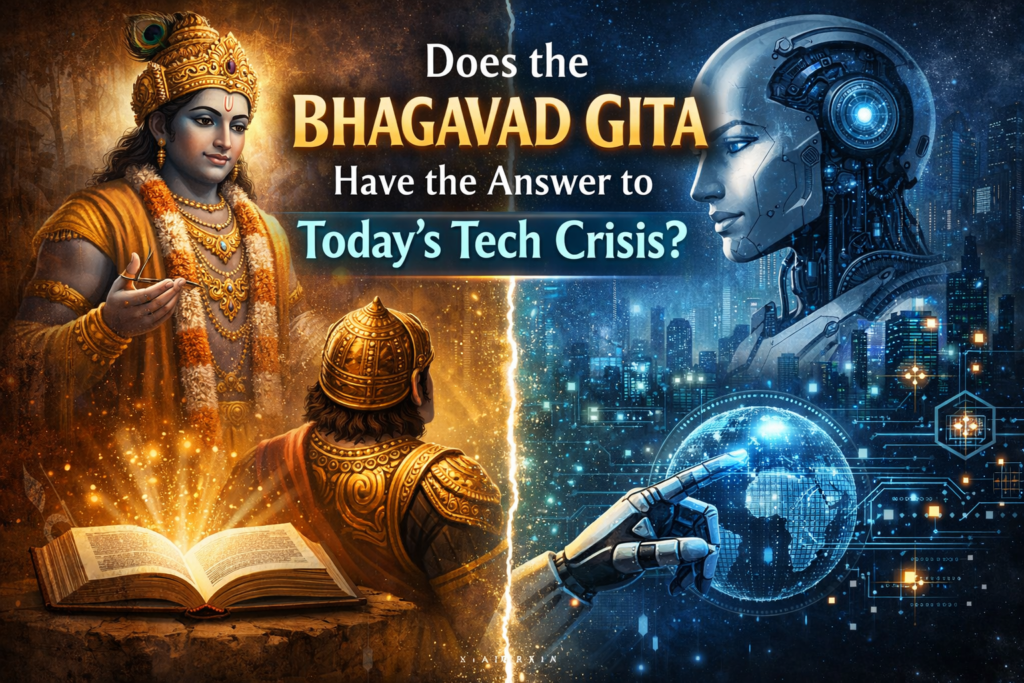
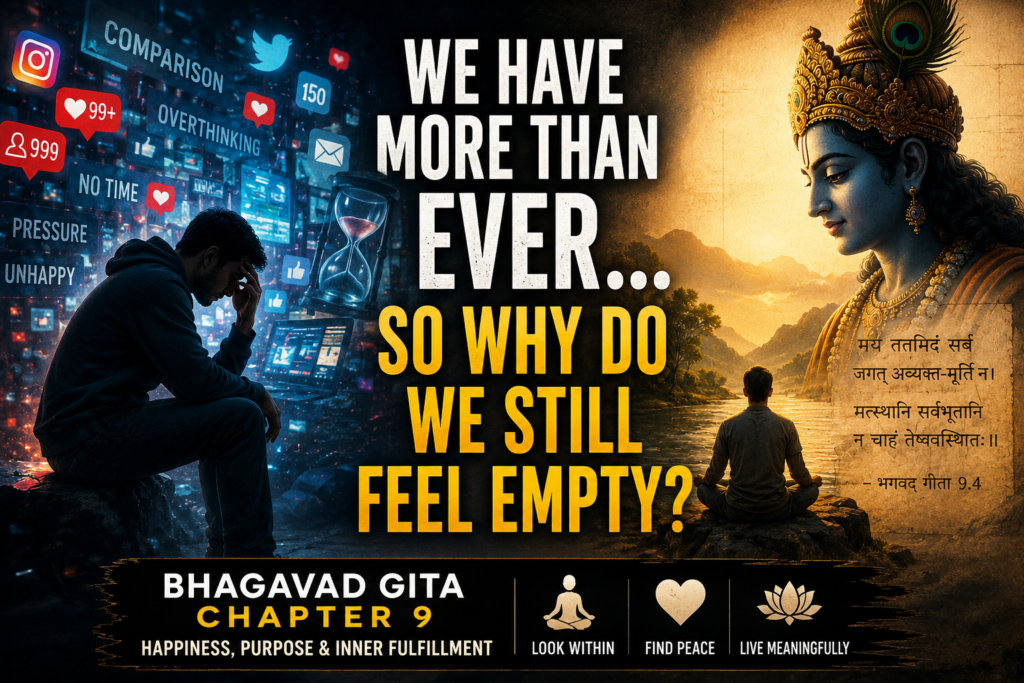
We live in the most connected generation in history.
People can communicate instantly across the world. Entertainment is available 24/7. Social media constantly shows success, luxury, achievements, and perfect lifestyles. Technology has made life faster, more convenient, and more connected than ever before.
Yet despite all this progress, many people still feel:
- mentally exhausted
- emotionally disconnected
- restless
- unfulfilled
This raises a difficult but honest question:
Why do people have more than ever… yet still feel empty inside?
This question connects deeply with Chapter 9 of the Bhagavad Gita, known as Raja Vidya Raja Guhya Yoga — the Yoga of Supreme Knowledge and Inner Wisdom.
In this chapter, Lord Krishna explains a timeless truth:
Real fulfillment does not come only from external things.
This message feels incredibly relevant in today’s technology-driven world.
Modern digital culture constantly encourages people to seek happiness externally. Social media rewards validation. Online platforms encourage comparison. Endless content keeps attention occupied every moment.
As a result, many people spend large parts of their lives:
- chasing digital approval
- comparing themselves with others
- consuming endless content
- searching for happiness through external stimulation
But despite having more access, more entertainment, and more connectivity than any previous generation, emotional emptiness continues to grow.
This is where the wisdom of Bhagavad Gita Chapter 9 becomes deeply meaningful.
Krishna teaches that lasting peace cannot depend entirely on external achievements or temporary pleasures. This idea directly connects with the modern digital environment.
Technology can provide:
- convenience
- entertainment
- connectivity
- information
But it cannot automatically provide:
- peace
- emotional fulfillment
- contentment
- inner stability
This is one of the biggest paradoxes of the modern age.
Technology has made life more connected externally—
but many people still feel disconnected internally.
That is the real challenge of today’s digital culture.
People are constantly online, yet often emotionally exhausted. They stay busy throughout the day, but rarely feel truly calm. They consume more content than ever before, but still search for meaning and fulfillment.
This is exactly why the message of Bhagavad Gita Chapter 9 feels so authentic today.
Krishna explains that happiness built only on external conditions is unstable, because external circumstances constantly change.
Success changes.
Money changes.
Recognition changes.
Social approval changes.
Digital trends change every day.
When happiness depends completely on these external things, peace becomes temporary.
This is why so many people continue chasing fulfillment while still feeling incomplete.
Chapter 9 offers a powerful reminder:
Inner fulfillment matters as much as external success.
This does not mean rejecting ambition, technology, or progress.
Instead, it means understanding that no amount of external stimulation can fully replace inner peace.
Modern society teaches people how to build careers, gain followers, and achieve success. But very few are taught how to develop emotional balance, contentment, and self-awareness.
That is why many people appear successful externally while struggling internally.
This is the timeless wisdom of Raja Vidya Raja Guhya Yoga.
It teaches that true fulfillment comes when external progress is balanced with inner stability.
Because happiness is not simply about achieving more—
it is also about understanding what truly matters.
And perhaps this is the most important lesson Chapter 9 offers for the digital age:
A world full of technology cannot replace the need for inner peace.
The modern world gives endless ways to stay distracted.
But lasting fulfillment comes from clarity, meaning, and emotional balance.
That is why the message of Bhagavad Gita Chapter 9 remains so powerful even today.
It speaks directly to a generation that has access to almost everything—
yet still searches for peace within itself.
In the end, true happiness is not measured only by what we collect externally.
It is measured by the peace we create within ourselves.
And that may be one of the most meaningful lessons Bhagavad Gita Chapter 9 offers for modern technology and digital life.
Read the complete series here:
Chapter 1: Fear, Confusion & Decision-Making
Chapter 2: Emotional Stability in a Distracted World
Chapter 3: Action, Discipline & Productivity
Chapter 4: Information vs True Knowledge
Chapter 5: Peace in an Always-Connected World
Chapter 6: Focus, Mind Control & Digital Distraction
Chapter 7: AI, Knowledge & Human Consciousness
Chapter 8: Focus, Purpose & Attention in the Digital Age