
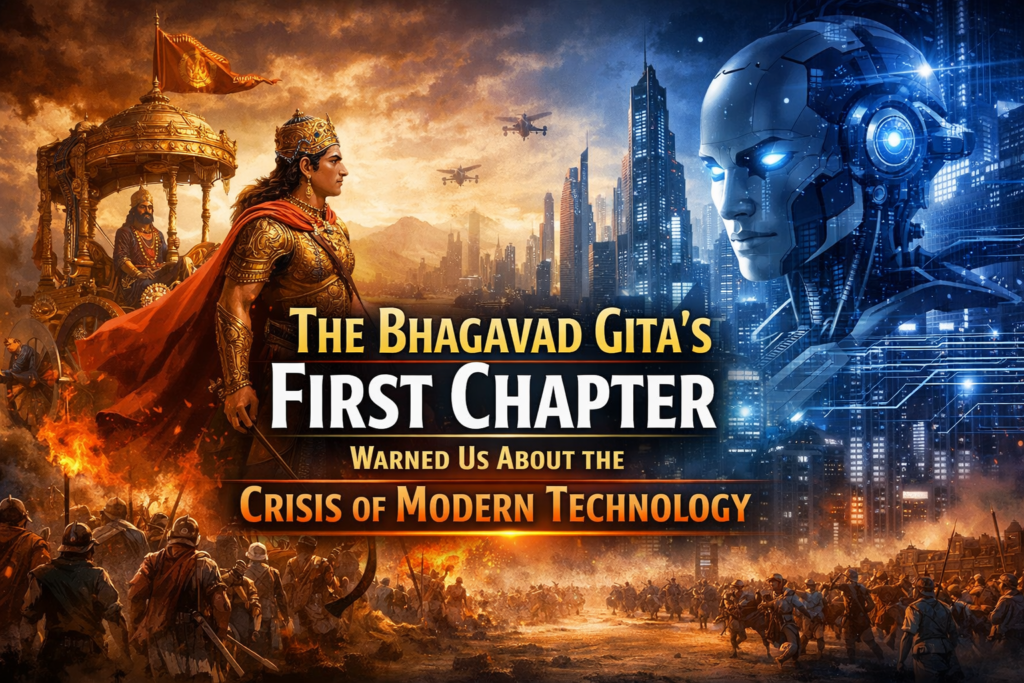

What if one of the oldest spiritual teachings in the world could explain one of the greatest challenges of the digital age?
The first chapter of the Bhagavad Gita, Arjuna Vishada Yoga, begins with a warrior standing on the battlefield, overwhelmed by the consequences of the power in his hands. Arjuna, though mighty and skilled, hesitates before action because he realizes that power without wisdom can lead to destruction.
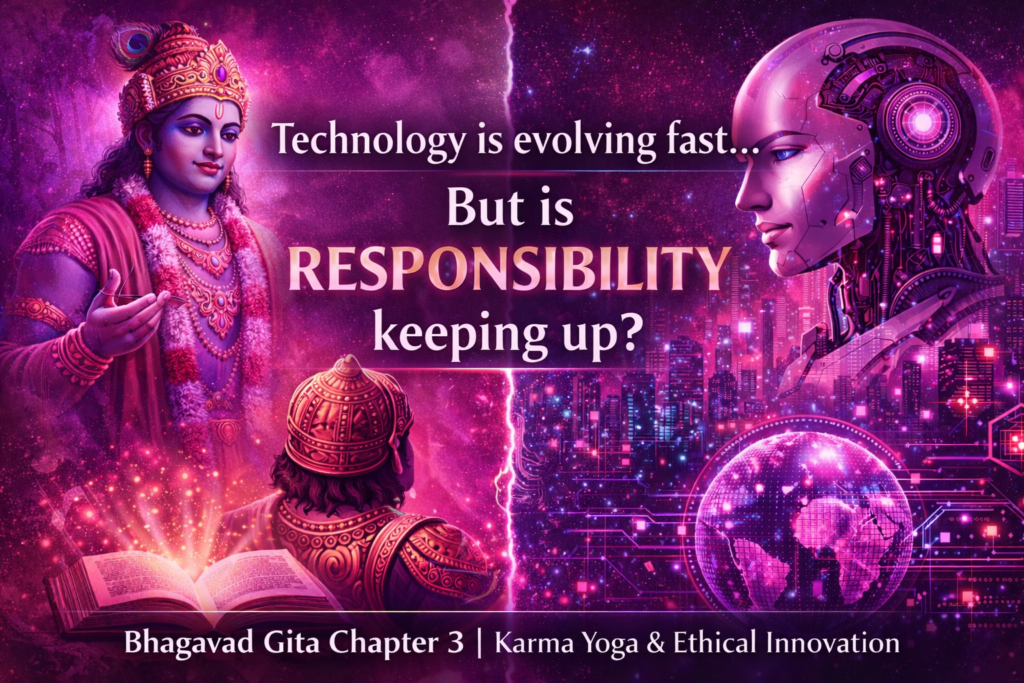
Surprisingly, this ancient moment mirrors the exact dilemma humanity faces with modern technology.
Today, we stand in the middle of a technological revolution. Artificial Intelligence, machine learning, automation, and massive digital systems are transforming the way we live and work. We possess incredible technological power—perhaps greater than ever before.
But the question remains:
Do we have the wisdom to use that power responsibly?
This is the same ethical question Arjuna faced in Chapter 1.
Arjuna’s crisis was not about fear of battle. It was about the consequences of action without moral clarity. He understood that possessing power is not enough; one must also understand the impact of using it.
This is exactly where the world stands today.
Technology is advancing faster than human ethics. Artificial Intelligence can make decisions, but ethical guidelines are still catching up. Automation increases efficiency, but creates fears of job displacement. Data-driven systems improve convenience, but threaten privacy and trust.
Humanity has built powerful tools, yet often moves forward without fully understanding the consequences.
That is why the message of Arjuna Vishada Yoga is so relevant today.
Power Without Wisdom Creates Destruction
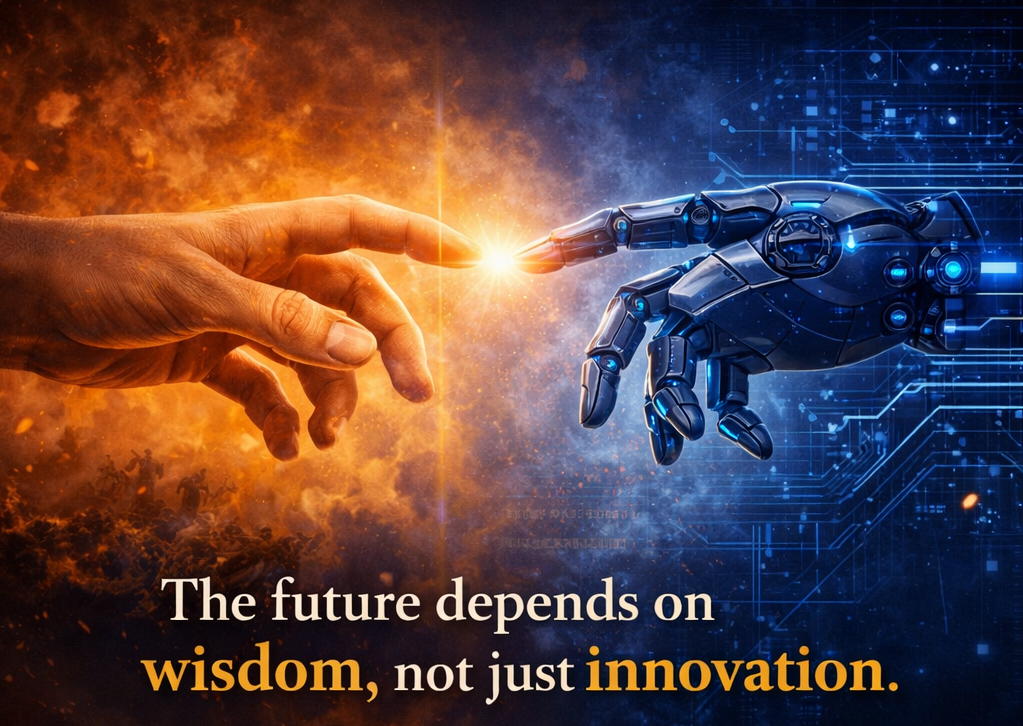
The first chapter of the Bhagavad Gita teaches that ethical reflection must come before action.
Arjuna pauses on the battlefield because he knows that action without wisdom can create irreversible harm.
Modern innovation often ignores this pause.
In the race to build faster systems, smarter algorithms, and more powerful technologies, humanity sometimes forgets to ask:
- Will this benefit society?
- Could this create harm?
- Is this ethically responsible?
- Are we innovating with wisdom?
These are the modern versions of Arjuna’s dilemma.
Artificial Intelligence can improve lives, but without ethical design, it can amplify bias. Automation can boost productivity, but without planning, it can increase inequality. Surveillance technologies can enhance security, but without safeguards, they can erode freedom.
This is why the ancient warning still matters:
Power without wisdom creates destruction.
The Modern Battlefield: Innovation vs Responsibility
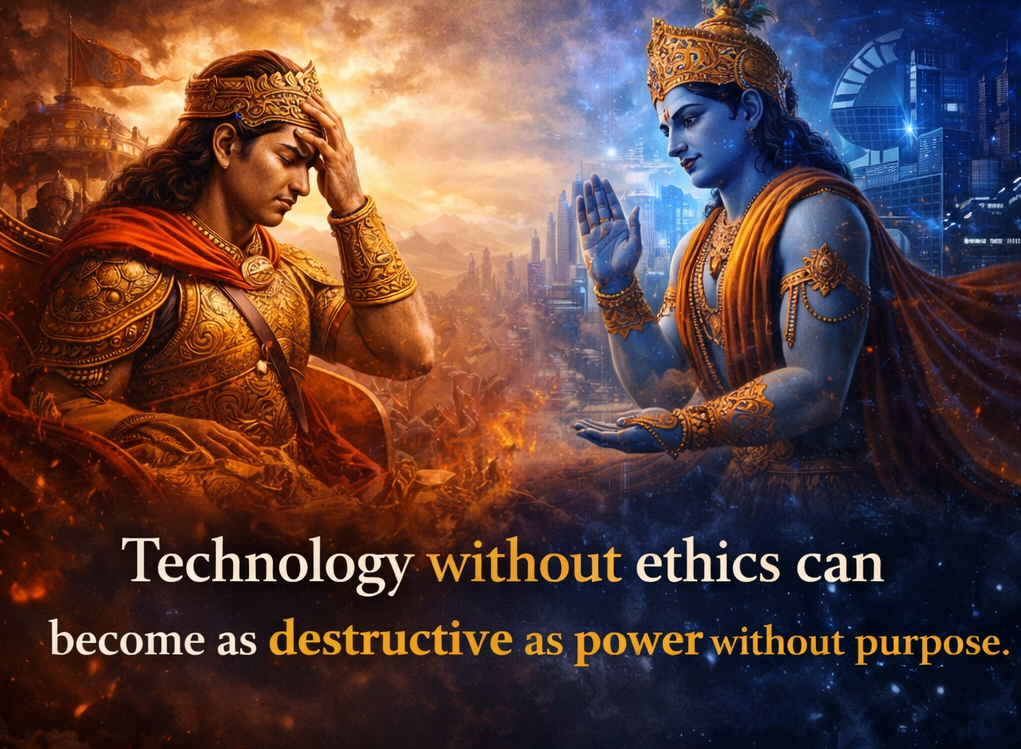
The battlefield of Kurukshetra is no longer just an ancient battlefield-it has become a symbol of our modern digital struggle.
Today’s battlefield is where:
- innovation meets ethics
- speed meets responsibility
- intelligence meets morality
- progress meets consequence
Like Arjuna, humanity stands between two paths: one driven by blind advancement, and another guided by thoughtful responsibility.
The real crisis of technology is not that machines are becoming smarter.
The real crisis is that human wisdom is not growing at the same pace as innovation.
This is the timeless truth hidden in Chapter 1 of the Bhagavad Gita.
Arjuna’s hesitation was not weakness-it was wisdom.
His pause reminds us that before building powerful systems, we must build strong ethical foundations.
Because the future will not be shaped only by how advanced our technology becomes
It will be shaped by the wisdom with which we choose to use it.
That is why Arjuna Vishada Yoga is not just a spiritual lesson—it is a modern warning.
In a world driven by AI, automation, and data, the first chapter of the Bhagavad Gita reminds us that technology without ethics can become dangerous.
The future of innovation depends not only on intelligence but on responsibility.
And perhaps the greatest lesson from Arjuna’s battlefield is this:
Before humanity builds smarter machines, it must become wiser itself.
Pingback: Why Do We Have Everything Yet Still Feel Empty? Bhagavad Gita Chapter 9 Explained for the Digital Age