
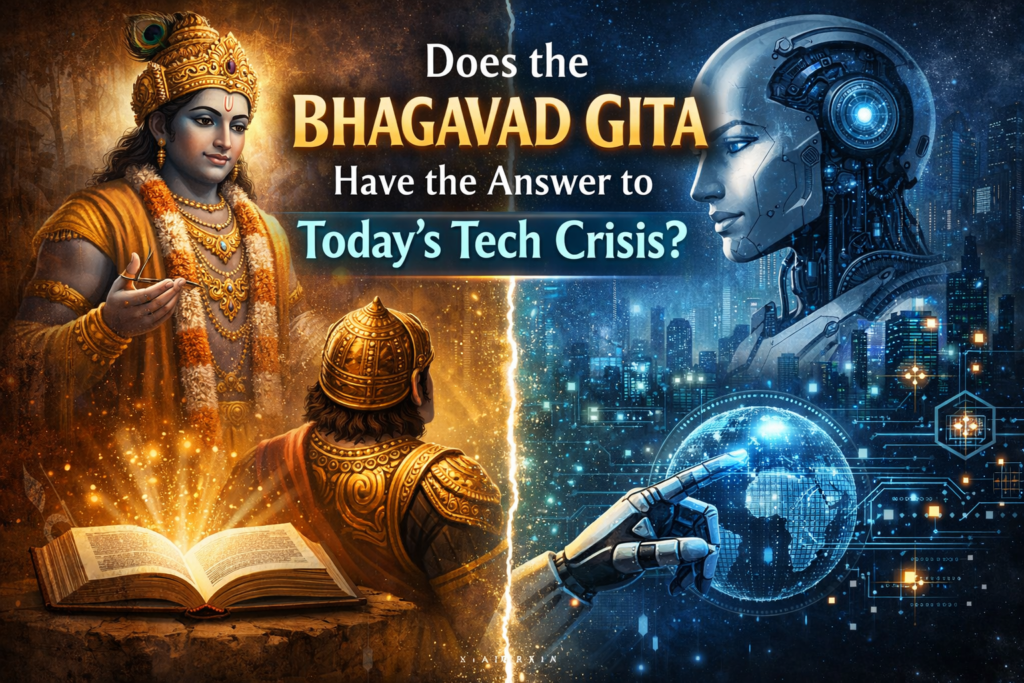
The world today is advancing at an extraordinary pace.
Artificial Intelligence is making decisions. Machines are learning faster than ever. Automation is transforming industries, and digital systems are influencing almost every part of human life.
Technology is becoming more powerful each day.
But in the middle of this progress, one important question remains:
Is human wisdom growing as fast as human innovation?
This question is not new.
Thousands of years ago, the second chapter of the Bhagavad Gita, Sankhya Yoga, addressed the same concern timelessly.
In Chapter 2, Arjuna stands in confusion on the battlefield, unable to act with clarity. In response, Lord Krishna teaches him one of the most important principles of life:
Action must be guided by wisdom.
This teaching is deeply relevant to the modern technological world.
Today, humanity possesses incredible technological power. Artificial Intelligence, machine learning, automation, and data systems are transforming society faster than ever before.
But power alone does not guarantee progress.
Without ethical wisdom, innovation can create serious problems:
- Artificial Intelligence can introduce bias
- Automation can increase inequality
- Data systems can threaten privacy
- Digital platforms can manipulate behaviour
These are not failures of technology.
They are failures of wisdom.
This is exactly why Sankhya Yoga matters in the digital age.
Krishna teaches Arjuna to rise above confusion and make decisions with clarity, balance, and understanding.
The same principle applies to modern innovation.
Today, many organizations focus on building smarter systems, faster algorithms, and more powerful technologies. But in this race for innovation, ethical reflection is often ignored.
The focus is often on:
- speed
- efficiency
- profit
- market advantage
while values like:
- fairness
- accountability
- responsibility
- human dignity
are left behind.
This imbalance creates the modern technology crisis.
The real issue is not that technology is becoming too advanced.
The real issue is that human values are not advancing at the same pace.
This is the warning hidden in Chapter 2 of the Bhagavad Gita.
Sankhya Yoga teaches that wisdom is greater than power.
Without wisdom, action becomes dangerous.
Without ethical thinking, innovation can harm the very society it is meant to serve.
This is what we see in many areas of modern technology.
Artificial Intelligence can improve healthcare, but if poorly designed it can create discrimination.
Automation can improve productivity, but without planning, it can replace livelihoods.
Digital systems can connect people, but they can also increase dependency and reduce privacy.
This is why technology needs more than intelligence.
It needs wisdom.
Krishna’s teaching in Chapter 2 emphasizes self-control, balanced thinking, and responsible action.
These principles are essential for the future of innovation.
Before building intelligent systems, society must ask:
- Is this ethical?
- Will this benefit humanity?
- Could this create harm?
- Are we innovating responsibly?
These are not merely technical questions.
They are moral questions.
And that is why the message of Sankhya Yoga is so powerful today.
As the world moves toward smarter machines, the need for wiser decisions becomes even greater.
Because the future will not be shaped only by technological advancement—
It will be shaped by the values guiding that advancement.
The second chapter of the Bhagavad Gita reminds us that progress without wisdom is incomplete.
Innovation without ethics creates risk.
Power without responsibility creates harm.
But when innovation is guided by wisdom, technology becomes a force for positive transformation.
This is the timeless lesson of Sankhya Yoga.
In the end, the greatest challenge of the digital era is not creating more intelligent machines.
The greatest challenge is ensuring that humanity remains wise enough to guide itself.
Because the future of technology depends not only on what we create—
It depends on the wisdom with which we create it.
Pingback: Why Do We Have Everything Yet Still Feel Empty? Bhagavad Gita Chapter 9 Explained for the Digital Age