
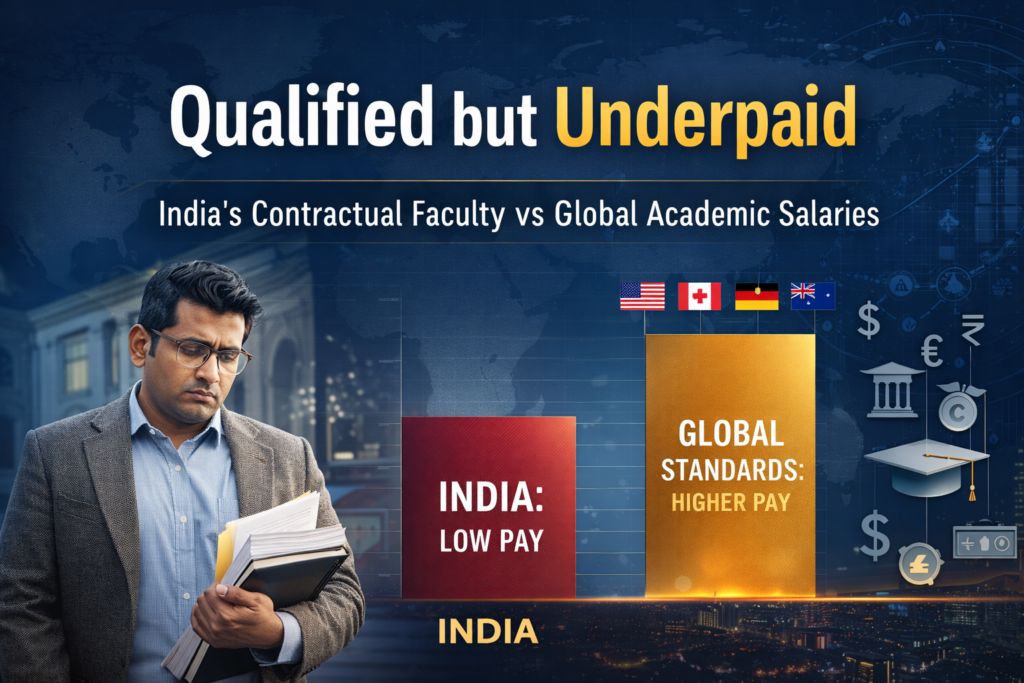
Higher education institutions rely heavily on contractual faculty to meet teaching demands. These educators often hold the same qualifications as permanent faculty—Master’s degrees, PhDs, NET, SET, and extensive teaching experience—yet their salaries, job security, and professional recognition remain significantly lower.
This raises an important question: Are contractual faculty truly paid according to their qualifications, or are universities exploiting temporary academic labor?
The answer becomes even more concerning when compared with academic employment practices in countries such as the United States, Canada, Germany, and Australia.
This article examines salary disparities, state-level inequalities in India, international comparisons, and the long-term impact on academic quality, revealing why contractual faculty remain one of the most undervalued groups in higher education.
Contractual Faculty in India: Qualified but Underpaid
In India, contractual faculty members are often appointed on short-term contracts, frequently renewed every semester or academic year. Despite holding the same academic qualifications as permanent faculty, they receive only a fraction of the salary.
According to salary estimates:
- The average guest faculty salary in India ranges between ₹18,000 and ₹50,000 per month
- Average contractual faculty salary ranges between ₹25,000 to ₹70,000 per month
- Permanent assistant professors under UGC 7th Pay Commission start at ₹57,700 basic pay + allowances, often crossing ₹80,000–₹1,00,000 per month
This means that many contractual teachers earn 40–60% less than regular faculty despite performing the same duties.
Table 1: India – Salary Comparison Between Contractual and Permanent Faculty
| Faculty Type | Average Monthly Salary | Benefits | Job Security |
|---|---|---|---|
| Guest Faculty | ₹18,000 – ₹50,000 | None | Very Low |
| Contractual Faculty | ₹25,000 – ₹70,000 | Limited | Low |
| Permanent Assistant Professor | ₹80,000 – ₹1,00,000+ | Full Benefits | High |
The disparity is not only financial, but it also affects promotion opportunities, research access, pension benefits, and professional dignity.
Lowest Paying States for Contractual Faculty in India
The salary of contractual faculty in India varies significantly by state. Some states pay slightly better, while others offer wages far below UGC norms.
Table 2: Approximate Monthly Salary of Contractual Faculty in Indian States
| State | Approximate Salary Range | Situation |
|---|---|---|
| Bihar | ₹20,000 – ₹30,000 | Very Low |
| Jharkhand | ₹20,000 – ₹35,000 | Low |
| Uttar Pradesh | ₹25,000 – ₹35,000 | Low |
| Rajasthan | ₹25,000 – ₹40,000 | Moderate |
| Jammu & Kashmir | ₹25,000 – ₹35,000 | Low |
| Punjab | ₹30,000 – ₹45,000 | Moderate |
| Delhi | ₹40,000 – ₹60,000 | Better |
States such as Bihar, Jharkhand, and Uttar Pradesh are among the lowest-paying, where even PhD-qualified teachers may earn salaries close to entry-level private-sector jobs.
In contrast, institutions in Delhi and some central universities offer relatively better pay, though still below permanent faculty scales.
How Other Countries Pay Contractual Faculty
Unlike India, many developed countries have structured pay systems for temporary faculty. Although adjunct and sessional faculty may not enjoy the same benefits as tenured professors, salary systems are generally more transparent and regulated.
United States: Better Pay but Persistent Inequality
In the United States, adjunct faculty are usually paid per course, ranging from $2,500 to $7,000 per course.
A faculty member teaching four courses per semester may earn:
- $20,000 to $50,000 annually
While this remains lower than tenure-track faculty, it is significantly more than Indian contractual salaries when adjusted for workload.
Table 3: USA Contract Faculty Pay
| Category | Approximate Earnings |
|---|---|
| Per Course | $2,500 – $7,000 |
| Annual (4 courses/semester) | $20,000 – $50,000 |
| Benefits | Limited |
| Transparency | High |
The U.S. still struggles with adjunct inequality, but salary transparency and legal accountability are stronger than in India.
Canada: Higher Wages and Institutional Support
In Canada, sessional lecturers may earn:
- CAD 7,000 to CAD 10,000 per course
Annual earnings can reach:
- CAD 50,000 to CAD 70,000
Many institutions also provide research support, union representation, and contractual protections, ensuring greater professional dignity.
Germany: Contract Faculty with Social Security
Germany follows a structured academic wage framework. Temporary faculty are often paid under regulated scales with:
- EUR 3,000 to EUR 5,000 per month
- Health insurance
- Pension contributions
- Employment rights
This model ensures that temporary faculty are professionally respected, even when contracts are limited.
Australia: High Hourly Compensation
Australian universities often pay sessional faculty on an hourly basis:
- AUD 100 to AUD 200 per teaching hour
This can translate into:
- AUD 60,000+ annually, depending on workload
This reflects recognition of academic qualifications and preparation time.
Global Comparison: India vs Other Countries
Table 4: Contractual Faculty Salary Comparison
| Country | Approximate Monthly Earnings | Benefits | Academic Dignity |
|---|---|---|---|
| India | ₹25,000 – ₹50,000 | Minimal | Low |
| USA | ₹1.6L – ₹4L equivalent | Limited | Moderate |
| Canada | ₹3L – ₹4.5L equivalent | Moderate | High |
| Germany | ₹2.8L – ₹4.7L equivalent | Strong | High |
| Australia | ₹3L – ₹5L equivalent | Strong | High |
This comparison shows that India pays the lowest among major academic systems, not only in absolute salary but also in benefits, dignity, and career stability.
Why This Inequality Matters
Low salaries for contractual faculty create several long-term problems:
1. Decline in Teaching Quality
Teachers working under financial stress cannot focus fully on teaching and mentoring.
2. Reduced Research Productivity
Contractual faculty often lack:
- research grants
- promotion pathways
- institutional support
This limits innovation and academic output.
3. Talent Migration
Highly qualified scholars move to:
- private universities
- industry roles
- foreign academic systems
Public institutions lose capable educators.
4. Institutional Dependency on Cheap Labor
Universities reduce costs by avoiding permanent recruitment and relying on temporary staff.
This creates a cycle of exploitation.
Final Conclusion
The evidence is clear: contractual faculty in India are not paid according to their qualifications.
A PhD-qualified contractual faculty member in India may earn ₹25,000–₹35,000 per month, while equally qualified temporary faculty in countries like the USA, Canada, Germany, and Australia earn multiple times more, along with better institutional respect.
India’s contractual faculty system reflects a deep structural imbalance:
- Equal qualifications
- Equal workload
- Unequal pay
- Unequal dignity
The problem is not merely salary, it is the systematic undervaluation of academic labor.
If higher education institutions expect quality teaching and global competitiveness, they must ensure that faculty compensation reflects qualifications, contributions, and professional dignity.
Until then, contractual faculty in India will remain qualified but undervalued, carrying the burden of higher education without receiving the recognition they deserve.