
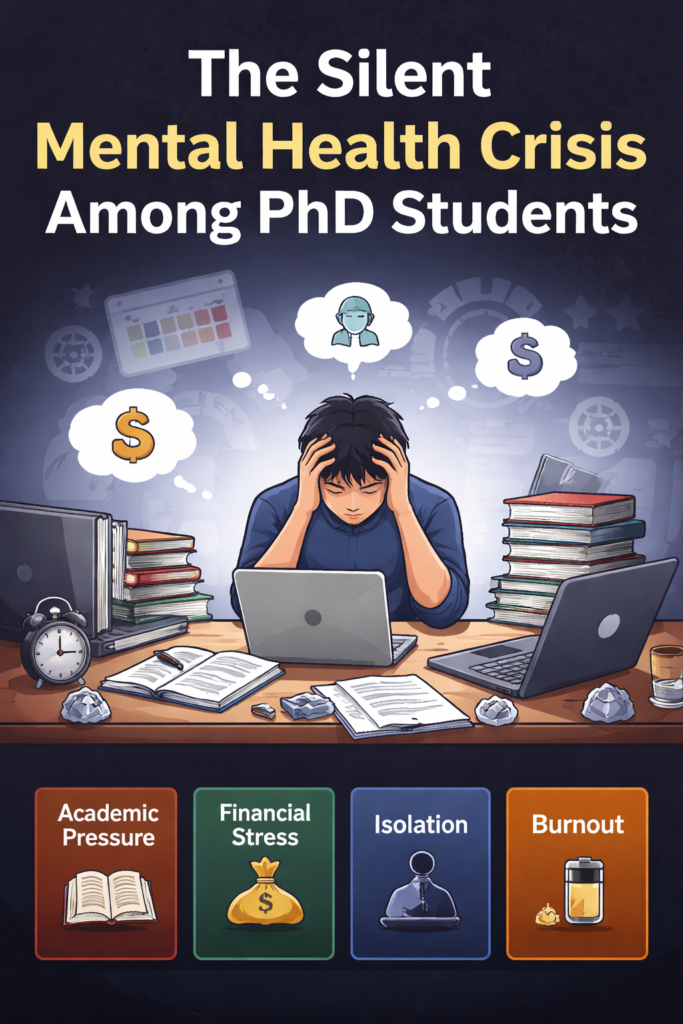
For many students, earning a PhD represents the highest level of academic success. It symbolizes expertise, dedication, and the promise of a meaningful career in research or higher education. But behind this respected academic milestone lies a reality that universities rarely acknowledge openly: a growing mental health crisis among PhD scholars.
Across the world, doctoral researchers are experiencing increasing levels of stress, anxiety, burnout, depression, and emotional exhaustion. What makes this issue more alarming is that much of this distress remains invisible. PhD scholars are often expected to manage enormous academic and emotional pressure while maintaining high levels of productivity. In many institutions, the culture rewards research output but ignores the human cost behind it.
This is no longer a personal issue affecting a few individuals. It is a structural problem in higher education—one that demands urgent attention.
Mental Health Problems Among PhD Scholars Are Higher Than in the General Population
Research from different countries has shown that doctoral students are at a much greater risk of mental health challenges than the general population.
A widely cited study published in Nature Biotechnology found that graduate students are over six times more likely to experience anxiety and depression than the general population. Another study published in Research Policy found that one in every two PhD students experiences psychological distress, and one in three is at risk of developing a psychiatric disorder.
These numbers suggest that the doctoral environment itself may be contributing to mental health difficulties.
Table 1: Mental Health Indicators Among PhD Scholars
| Mental Health Indicator | Reported Level |
|---|---|
| Psychological Distress | 50% |
| Risk of Psychiatric Disorder | 32% |
| Anxiety/Depression Risk | 6 times higher than general population |
| Burnout Risk | High |
These figures indicate that the pressure associated with doctoral study is not temporary stress it often reaches a clinically concerning level
Why Is the PhD Journey So Mentally Demanding?
The PhD process is very different from other educational programs. Unlike undergraduate or postgraduate study, doctoral research involves long periods of uncertainty, repeated setbacks, limited structure, and delayed rewards.
PhD scholars are expected to:
- produce original research
- publish papers
- meet deadlines
- secure funding
- satisfy supervisors
- compete for limited academic jobs
This means the pressure is not only academic—it is also financial, professional, and emotional.
When progress is slow or results are uncertain, scholars often begin to question their abilities. This creates a cycle of self-doubt and stress
Financial Insecurity Is a Major Source of Stress
One of the most significant causes of mental stress among research scholars is financial uncertainty.
Many PhD students depend on:
- scholarships
- fellowships
- stipends
- project grants
In countries like India, delays in fellowship payments are a common issue. Scholars often wait months for funding while continuing research work. This creates serious financial instability.
Without regular income, many scholars struggle with:
- rent
- food expenses
- research costs
- family obligations
The emotional pressure of financial insecurity directly affects concentration, motivation, and mental well-being.
Table 2: Financial Challenges Faced by PhD Scholars
| Financial Issue | Mental Impact |
|---|---|
| Delayed stipend | Anxiety |
| Low funding | Chronic stress |
| Research expenses | Financial pressure |
| Family dependency | Emotional burden |
When scholars cannot meet basic living needs, academic performance and mental health both suffer.
Supervisor Relationships Can Make or Break the Doctoral Experience
Supervisors play a critical role in a scholar’s progress.
They influence:
- research approval
- publication support
- thesis evaluation
- academic recommendations
A supportive supervisor can build confidence. But when supervision is poor, the impact on mental health can be severe.
Common supervisory issues include:
- delayed feedback
- poor communication
- excessive criticism
- unrealistic expectations
- lack of support
Because scholars depend on supervisors for progress, they often feel powerless when problems arise.
This imbalance can create long-term emotional stress.
Isolation Is One of the Most Overlooked Causes of Distress
Unlike classroom-based education, PhD research is often lonely.
Many scholars work alone for years, often separated from:
- classmates
- peer groups
- social activities
- family support
This isolation may seem manageable at first, but over time it can lead to:
- loneliness
- anxiety
- emotional exhaustion
- depression
Without peer interaction, academic setbacks feel heavier.
The loneliness of doctoral work is one of the least discussed but most harmful aspects of the PhD journey.
Academic Culture Often Normalizes Burnout
One of the most troubling realities in academia is that burnout is often treated as normal.
Long working hours, publication pressure, constant deadlines, and emotional exhaustion are frequently seen as part of “academic dedication.”
Scholars may feel guilty for resting because the system rewards constant productivity.
This leads to:
- sleep deprivation
- chronic fatigue
- reduced motivation
- mental exhaustion
Table 3: Signs of Burnout Among PhD Scholars
| Burnout Sign | Common Effect |
|---|---|
| Fatigue | Reduced productivity |
| Anxiety | Difficulty focusing |
| Isolation | Emotional withdrawal |
| Loss of motivation | Academic decline |
When burnout becomes normalized, mental health deteriorates silently.
Uncertain Career Prospects Intensify Mental Pressure
Many PhD scholars begin doctoral research expecting academic career opportunities.
But the reality is often uncertain.
After years of effort, scholars face:
- limited faculty positions
- temporary contracts
- low academic salaries
- high competition
The fear of investing years into an uncertain future creates constant anxiety.
Scholars begin to ask:
- Will this degree lead to stability?
- Will I get an academic job?
- Was the sacrifice worth it?
This uncertainty affects emotional well-being throughout the PhD journey.
Institutions Focus on Output but Neglect Well-Being
Universities often measure doctoral success through:
- publications
- thesis completion
- rankings
- research output
But far less attention is given to:
- emotional well-being
- counseling access
- scholar support systems
This creates an academic culture where scholars feel valued for productivity but unsupported as individuals.
The result is that mental health struggles remain hidden until they become severe.
Why This Crisis Matters
The mental health of PhD scholars affects not only individuals but also the future of higher education.
When scholars face extreme stress:
- Research quality declines
- innovation suffers
- dropout rates increase
- talent leaves academia
A system that damages the well-being of its researchers cannot sustain academic excellence.
Protecting scholars’ mental health is not a welfare issue it is a research quality issue.
Final Conclusion
The mental health crisis among PhD scholars is real, serious, and deeply rooted in the structure of doctoral education.
The evidence is clear:
- high psychological distress
- financial instability
- supervisory pressure
- isolation
- burnout
- uncertain careers
These are not isolated struggles; they are common experiences across academic systems.
If universities continue to prioritize research output while neglecting scholar well-being, the cost will be measured in lost talent, broken motivation, and declining academic quality.
The future of higher education depends on the people who produce knowledge.
And those people need support, dignity, and mental well-being, not just deadlines.
Because no academic achievement is worth sacrificing mental health, and no scholar should suffer silently in pursuit of a PhD.
References
- Evans, T. M., Bira, L., Gastelum, J. B., Weiss, L. T., & Vanderford, N. L. (2018).
Evidence for a mental health crisis in graduate education.
Nature Biotechnology, 36(3), 282–284.
https://doi.org/10.1038/nbt.4089 - Levecque, K., Anseel, F., De Beuckelaer, A., Van der Heyden, J., & Gisle, L. (2017).
Work organization and mental health problems in PhD students.
Research Policy, 46(4), 868–879.
https://doi.org/10.1016/j.respol.2017.02.008 - Casey, C., Taylor, J., Knight, F., & Trenoweth, S. (2023).
Understanding the Mental Health of Doctoral Students.
Encyclopedia, 3(4), 1523–1536.
https://doi.org/10.3390/encyclopedia3040109 - Mills, L., Read, G. J. M., Bragg, J. E., Hutchinson, B. T., & Cox, J. A. (2024).
A study into the mental health of PhD students in Australia.
Scientific Reports, 14.
https://www.nature.com/articles/s41598-024-72661-z - Hall, S. (2024).
How PhD students and other academics are fighting the mental-health crisis in science.
Nature.
https://www.nature.com/articles/d41586-024-02225-8