India’s higher education system is witnessing a growing contradiction—one that directly affects the future of research in the country.
Every year, thousands of students spend months and even years preparing for highly competitive examinations such as UGC-NET and JRF, hoping to secure admission into PhD programmes and build careers in research and academia.
For these scholars, qualifying for NET or JRF is considered a significant academic achievement. It reflects research aptitude, academic readiness, and the ambition to contribute to innovation and knowledge creation.
Yet, after clearing these examinations, many scholars encounter a harsh reality:
Even after qualifying, getting admission into a PhD programme remains uncertain.
At the same time, universities across India continue to report vacant PhD seats, unfilled research positions, and underutilised academic capacity.
This creates a serious and deeply troubling question:
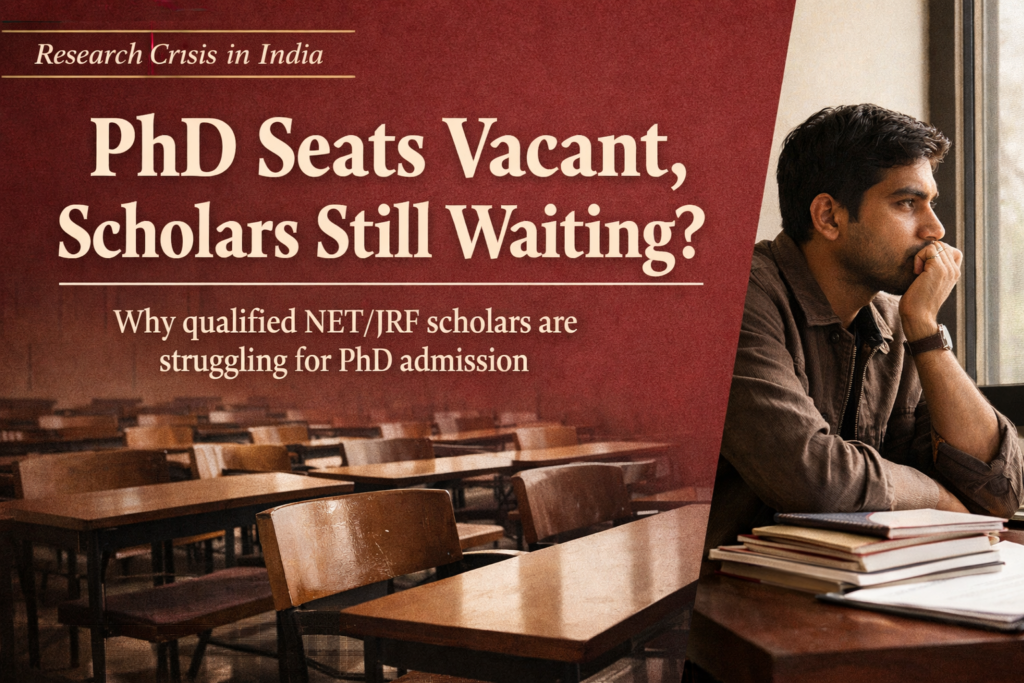
If PhD seats are available, why are qualified scholars still struggling for admission?
This is one of the most important, but least discussed, crises in Indian higher education.
The Growing Number of Qualified Scholars
India is not facing a shortage of research aspirants.
In fact, the number of candidates qualifying for PhD eligibility through UGC-NET is increasing significantly.
In the UGC NET June 2025 cycle, over 1.28 lakh candidates qualified for PhD admission eligibility, marking a 14% increase from previous cycles. This suggests that more students are becoming academically eligible and willing to enter doctoral research.
At first glance, this should be a positive sign.
A larger pool of qualified scholars should naturally strengthen the research ecosystem, increase doctoral enrolment, and improve the country’s academic output.
But the reality tells a different story.
Despite this rise in eligible candidates, doctoral admissions remain limited, and many PhD seats remain vacant across universities.
The problem is not the lack of candidates.
The problem is the system’s inability to absorb them.
Vacant Seats, Yet No Access
This is where the paradox becomes visible.
Universities officially announce PhD seats every admission cycle, yet many of these seats remain unfilled.
For instance, universities have reported hundreds of unoccupied research seats in various departments due to administrative issues, faculty shortages, or lack of approved supervisors.
This means:
- Candidates are available
- Seats are available
- Admissions are still not happening
This contradiction reveals a structural problem in the doctoral admission ecosystem.
The issue is no longer about eligibility—it is about access.
Why Are Scholars Still Struggling?
The reasons behind this crisis are deeply institutional.
1. Lack of Research Supervisors
One of the biggest reasons for vacant PhD seats is the shortage of eligible supervisors.
Many universities face:
- faculty vacancies
- overloaded supervisors
- departments with limited approved guides
Without supervisors, even sanctioned PhD seats cannot be filled.
This creates a situation where research seats exist on paper but are inaccessible in practice.
2. Administrative Delays in PhD Admissions
Many institutions delay:
- PhD notifications
- entrance tests
- interviews
- supervisor allocation
These delays often stretch admissions over months, discouraging candidates and disrupting the academic cycle.
For scholars waiting to begin research, such delays create uncertainty and frustration.
3. Funding Opportunities Are Extremely Limited
Another major barrier is the shortage of research funding.
While 1.28 lakh candidates qualified for PhD eligibility, only 5,269 scholars received JRF fellowships.
That means the vast majority of qualified candidates receive no financial support.
For many students, pursuing a PhD without fellowship is financially impossible.
As a result, many deserving scholars are forced to abandon or postpone research.
This creates an unfortunate category of students:
Qualified for research, but unable to afford it.
4. Policy and Institutional Mismatch
India’s policy framework strongly promotes research growth.
Initiatives under the National Education Policy (NEP) emphasise innovation, doctoral education, and improved research productivity.
However, institutional readiness has not kept pace.
Universities continue to struggle with:
- faculty shortages
- weak infrastructure
- funding constraints
- Poor admission management
As a result, policy goals and ground realities remain disconnected.
The Bigger Impact on India’s Research Future
This problem affects far more than individual scholars.
When PhD seats remain vacant while qualified candidates are denied access, the nation loses:
- future researchers
- future faculty members
- innovation capacity
- academic productivity
India aims to strengthen its global standing in research and innovation, but such institutional inefficiencies slow that progress.
Every unfilled PhD seat represents:
a missed opportunity for knowledge creation
Every qualified scholar unable to enter research represents:
a loss of national talent
This is not just an admission problem—it is a national research capacity problem.
The Real Crisis: Eligibility Without Opportunity
India has:
- talented scholars ready for research
- universities with doctoral seats
- policies encouraging innovation
Yet the system fails to connect these three.
This is the real crisis.
The challenge is no longer qualifying for research—it is gaining entry into a system that cannot effectively support the scholars it produces.
Until this gap between eligibility and opportunity is addressed, thousands of deserving NET/JRF scholars will continue to struggle, while universities continue to report vacant PhD seats.
That contradiction reflects a serious inefficiency in India’s academic framework.
And unless it is resolved, the country risks weakening the very research ecosystem it seeks to strengthen.
What Needs to Change
To address this issue, universities and policymakers must focus on:
- recruiting more faculty supervisors
- filling academic vacancies
- expanding fellowship opportunities
- improving admission timelines
- strengthening research infrastructure
Without these reforms, the gap between research potential and research opportunity will continue to grow.
Conclusion
India does not lack talent.
It does not lack aspiring researchers.
It does not even lack PhD seats.
What it lacks is a system capable of connecting talent with opportunity.
That is why thousands of PhD seats remain vacant while NET and JRF scholars continue struggling for admission.
And until that system improves, India’s dream of becoming a research-driven knowledge economy will remain incomplete.