Introduction
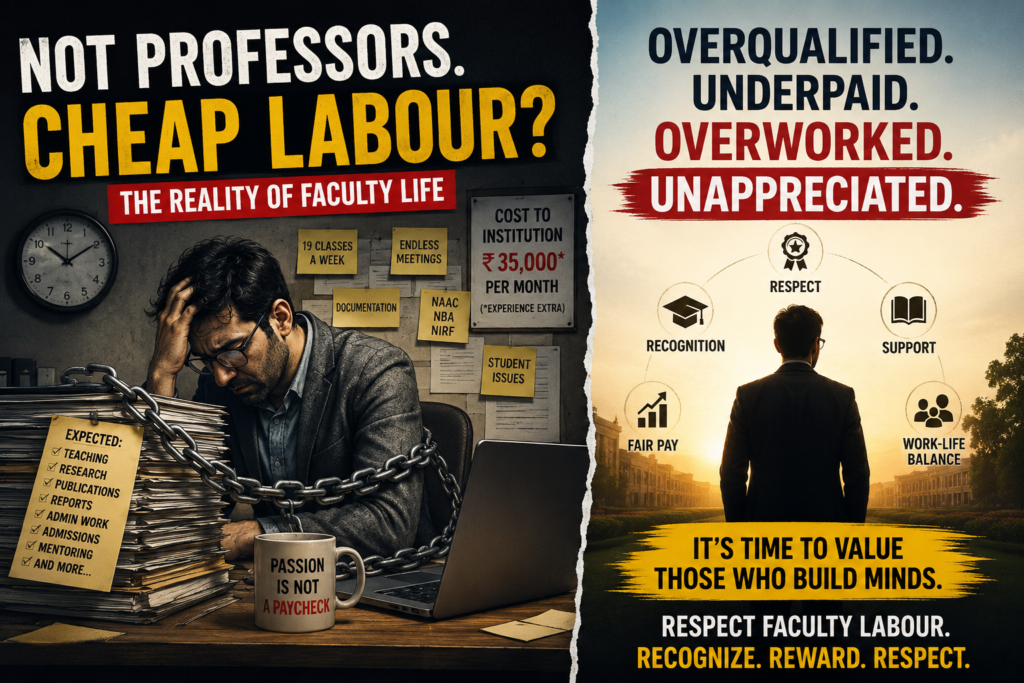
A single image is going viral across social media.
It shows a professor chained to endless responsibilities—teaching, research, administration, reports—while being underpaid and overworked.
The message is bold:
“Not Professors. Cheap Labour.”
At first glance, it may seem exaggerated.
But for many educators, it feels real.
So the real question is:
Is this just internet drama… or a deeper truth about the education system?
The Reality Behind the “Professor” Title
Most people assume that professors only teach and do research.
But the actual workload is far more demanding.
A typical faculty member handles:
- Teaching multiple subjects
- Research and publications
- Administrative work
- Accreditation tasks (NAAC, NBA, NIRF)
- Student mentoring
- Exam duties and evaluations
- Admissions and marketing
- Workshops and continuous reporting
In many institutions, this is not optional—it is expected.
The result?
Long hours, constant pressure, and no clear boundaries.
The Salary vs Expectation Gap
One of the biggest concerns is compensation.
In several institutions, especially at the entry level, faculty salaries are relatively low compared to the workload.
At the same time, expectations continue to increase:
- Publish in reputed journals
- Contribute to rankings
- Maintain documentation
- Participate in institutional branding
The reality becomes clear:
High expectations
Low financial reward
This gap creates frustration, especially for young academicians entering the field with passion.
“Passion Is Your Paycheck” — A Problematic Idea
A common phrase often heard in academia is:
“Passion is your paycheck.”
While passion is important, it cannot replace fair compensation.
Teaching is not just a passion-driven role.
It requires:
- Years of education
- Continuous research
- Professional expertise
When passion is used to justify low pay, it leads to burnout and dissatisfaction.
Impact on Students and Education
This issue does not affect only faculty—it impacts students as well.
When educators are overworked:
- Teaching quality may decline
- Innovation reduces
- Research becomes mechanical
- Student engagement drops
A stressed educator cannot create an inspiring classroom.
Is This True Everywhere?
It is important to stay balanced.
Not all institutions operate this way.
Many reputed universities provide:
- Good salaries
- Research support
- Healthy work environments
However, the concern arises where:
Cost-cutting becomes more important than quality education.
What Needs to Change
Improving the system requires structural changes:
- Fair salary structures
- Balanced workload
- Recognition of faculty efforts
- Reduced unnecessary administrative burden
- Investing in faculty means investing in students.
For Those Planning an Academic Career
If you are considering becoming a professor:
Make informed decisions.
Focus on:
- Choosing the right institution
- Building strong research skills
- Exploring funded PhD opportunities
- Understanding career growth
Smart choices can help you avoid common challenges in academia.
Explore Better Academic Opportunities
Explore Fully Funded PhD Programs
https://pranavratta.com/category/research-articles/ Learn Research & Career Strategies
Final Thought
The viral image may be dramatic—but the issue it highlights is real.
Teaching is one of the most important professions in society.
But importance should come with respect.
Not just in words
But in structure, support, and compensation
Because in the end:
Strong education systems are built on respected educators.