
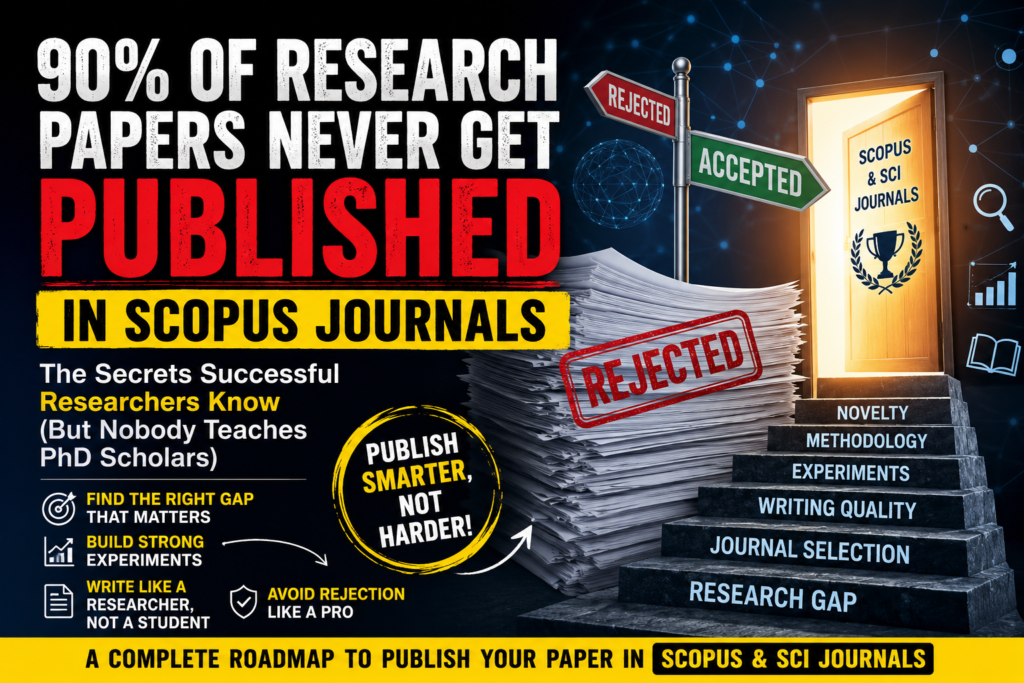
Every PhD Scholar Wants to Publish. Few Understand Why Papers Actually Get Rejected.
Walk into any university research lab and ask scholars what they want.
The answer is almost always the same:
“I want to publish my paper in a good Scopus or SCI journal.”
Yet thousands of manuscripts are rejected every month.
What’s surprising is that many of these papers contain good research.
The real problem is not always the research.
The problem is that researchers are solving publication problems at the wrong stage.
Most scholars start thinking about publication after completing their research.
Successful researchers start thinking about publication before beginning their research.
That single difference changes everything.
The Secret Most Published Researchers Know
Many young researchers believe that publication success depends on writing skills.
Others think publication depends on English proficiency.
Some assume acceptance depends on luck or reviewer mood.
None of these are the primary reasons.
The biggest predictor of publication success is whether the research was designed for publication from the beginning.
Top researchers ask questions such as:
- Which journal will publish this work?
- What problem does this journal care about?
- What type of novelty does this journal prefer?
- What experimental evidence will reviewers expect?
Before collecting a single piece of data, they already understand the destination.
Most rejected papers never had a destination.
Why Reviewers Lose Interest Within Minutes
Researchers imagine reviewers reading every sentence carefully.
Reality is different.
Experienced reviewers often identify major weaknesses quickly.
They immediately look for:
What is the research gap?
What is new?
Why is this important?
How is it better than existing work?
If these answers are unclear, the manuscript starts losing momentum.
A reviewer should never have to search for the contribution.
The contribution should be impossible to miss.
The Research Gap Is Worth More Than the Algorithm
This may sound controversial.
A strong research gap with a moderate solution often gets published.
A sophisticated solution with no meaningful research gap often gets rejected.
Many scholars spend months improving accuracy from 95.2% to 95.8%.
Reviewers rarely get excited about tiny improvements.
What excites reviewers is solving a real problem.
For example:
Instead of improving a model by 0.5% accuracy,
Can you reduce computational cost?
Can you improve privacy?
Can you increase scalability?
Can you reduce energy consumption?
Can you make the solution usable in real-world environments?
Impact matters more than small numerical improvements.
The Biggest Mistake Researchers Make During Literature Review
Most literature reviews look like this:
Author A did this.
Author B proposed that.
Author C achieved 94% accuracy.
Author D achieved 96% accuracy.
This is not a literature review.
It is a reading list.
A high-quality literature review should behave like an investigation.
It should reveal:
- What has already been solved.
- What remains unsolved.
- Why previous solutions are insufficient.
- What opportunity exists for new research.
When reviewers finish reading your literature review, they should naturally arrive at the conclusion:
“Yes, this study is needed.”
The Hidden Psychology of Journal Editors
Editors receive hundreds of submissions.
They do not have unlimited time.
They look for signals.
Certain signals immediately increase confidence:
- Professional formatting
- Strong abstract
- Clear contributions
- High-quality figures
- Recent references
- Logical structure
Other signals create concern:
- Poor grammar
- Weak figures
- Outdated references
- Generic titles
- Unclear objectives
Researchers often underestimate presentation.
Presentation is not decoration.
Presentation communicates professionalism.
Why Novelty Does Not Mean Reinventing Science
One of the most dangerous myths in academia is that novelty requires a revolutionary breakthrough.
Not true.
Many published papers introduce incremental innovation.
Novelty can come from:
A new framework
A new methodology
A new application area
A new dataset
A new evaluation approach
A new combination of technologies
For example:
Blockchain alone is not novel.
Machine learning alone is not novel.
IoT alone is not novel.
But combining them effectively to solve a healthcare challenge may create publishable novelty.
Innovation often occurs at intersections.
The Publication Formula Nobody Teaches
After studying hundreds of successful papers, a pattern emerges.
Publication success can often be described as:
Meaningful Problem
Clear Research Gap
Visible Novelty
Strong Experiments
Professional Writing
Appropriate Journal Selection
=
High Probability of Acceptance
Notice something interesting.
Luck is not part of the formula.
Why Smart Researchers Get Rejected
Intelligence alone does not guarantee publication.
Many brilliant researchers struggle because they focus entirely on technical work.
Publication requires additional skills:
- Scientific storytelling
- Research positioning
- Academic writing
- Reviewer communication
- Journal targeting
Research and publication are related.
But they are not identical.
A great study poorly presented may fail.
A good study professionally communicated often succeeds.
The Question Every Researcher Should Ask
Most scholars ask:
“How can I get this paper accepted?”
The better question is:
“How can I remove every reason for rejection?”
When you eliminate:
- Weak novelty
- Poor writing
- Weak validation
- Insufficient references
- Formatting errors
- Unsupported claims
Acceptance becomes a natural outcome rather than a matter of chance.
Final Thoughts
Publishing in Scopus or SCI journals is not reserved for a select group of researchers.
It is a skill.
Like any skill, it can be learned, refined, and mastered.
The researchers who publish consistently are not necessarily the smartest people in the room.
They are often the most systematic.
They choose meaningful problems.
They identify genuine gaps.
They create evidence-based solutions.
And most importantly, they understand a truth that many researchers discover too late:
A paper is not accepted because it is written well.
A paper is accepted because the research was designed to be publishable from the very beginning.
The next time you start a research project, don’t ask, “What paper can I write?”
Ask, “What problem is worth solving?”
The answer to that question often determines whether your paper becomes another rejection email—or your next Scopus publication.