Artificial Intelligence is reshaping the future of healthcare, transportation, smart cities, robotics, agriculture, and sustainability. At the heart of this transformation lies Computer Vision—one of the fastest-growing fields in AI.
If you’re a researcher, faculty member, PhD scholar, master’s student, or industry professional, here’s an exciting opportunity to showcase your work on an international platform.
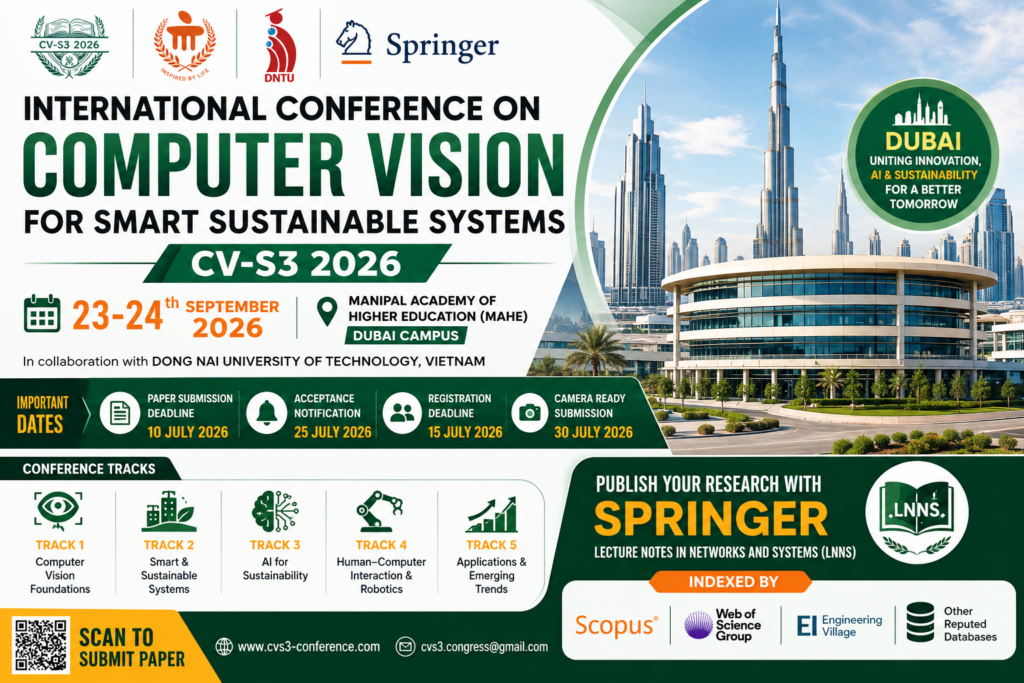
The International Conference on Computer Vision for Smart Sustainable Systems (CV-S3 2026) is now accepting research papers for its upcoming conference to be held on 23–24 September 2026 at Manipal Academy of Higher Education (MAHE), Dubai Campus, in collaboration with Dong Nai University of Technology (DNTU), Vietnam.
Accepted papers will be published in Springer Lecture Notes in Networks and Systems (LNNS), with indexing in Scopus, EI Compendex, Web of Science (where applicable), and other major databases, subject to Springer indexing policies.
Why CV-S3 2026 Should Be on Every Researcher’s Radar
Publishing quality research is becoming increasingly competitive. Researchers today are looking for conferences that not only provide international exposure but also offer publication through reputed publishers.
CV-S3 2026 combines three important aspects:
- International collaboration
- Emerging AI research themes
- Springer publication opportunities
Whether your work focuses on deep learning, image processing, robotics, sustainable computing, or intelligent systems, this conference provides a suitable platform for presenting innovative research.
Conference Highlights
Conference Name
International Conference on Computer Vision for Smart Sustainable Systems (CV-S3 2026)
Conference Dates
23–24 September 2026
Venue
Manipal Academy of Higher Education (MAHE), Dubai Campus
Collaborating Institution
Dong Nai University of Technology (Vietnam)
Publisher
Springer – Lecture Notes in Networks and Systems (LNNS)
Indexed In
- Scopus
- EI Compendex
- Web of Science (where applicable)
- Other reputed indexing databases
Conference Tracks
Researchers can submit papers in various emerging domains including:
Track 1
Computer Vision Foundations
Track 2
Smart and Sustainable Systems
Track 3
Artificial Intelligence for Sustainability
Track 4
Human-Computer Interaction and Robotics
Track 5
Applications and Emerging Trends
These tracks encourage interdisciplinary research that combines Artificial Intelligence with practical real-world applications.
Important Dates
| Event | Date |
|---|---|
| Paper Submission Deadline | 10 July 2026 |
| Acceptance Notification | 25 July 2026 |
| Registration Deadline | 15 July 2026 |
| Camera Ready Submission | 30 July 2026 |
| Conference Dates | 23–24 September 2026 |
Tip: Don’t wait until the last day. Early submissions give you more time to address reviewer comments if revisions are requested.
Who Should Submit?
CV-S3 2026 welcomes submissions from:
- PhD Scholars
- Master’s Students
- Faculty Members
- Research Scientists
- Industry Professionals
- AI Engineers
- Computer Vision Researchers
- Robotics Engineers
- Machine Learning Practitioners
If your research contributes to solving real-world challenges using AI and Computer Vision, this conference could be an excellent publication opportunity.
Why Computer Vision Research Matters Today
Computer Vision has become one of the most influential branches of Artificial Intelligence. From autonomous vehicles and medical image diagnosis to surveillance systems, industrial automation, precision agriculture, and smart cities, its applications continue to expand rapidly.
Conferences like CV-S3 2026 play a vital role in bringing together researchers working on innovative solutions that can contribute to a more sustainable and intelligent future.
Official Conference Links
🌐 Official Conference Website
📝 Paper Submission Portal (Microsoft CMT)
🏛️ Host Institution (MAHE Dubai)
📚 Springer LNNS Series
Final Thoughts
Finding the right conference is just as important as writing a strong research paper. CV-S3 2026 offers an excellent combination of international collaboration, emerging AI themes, and publication through Springer, making it an attractive venue for researchers in Computer Vision, Artificial Intelligence, Robotics, and Sustainable Computing.
If your work aligns with the conference themes, start preparing your manuscript early and ensure it meets Springer formatting guidelines to maximize your chances of acceptance.