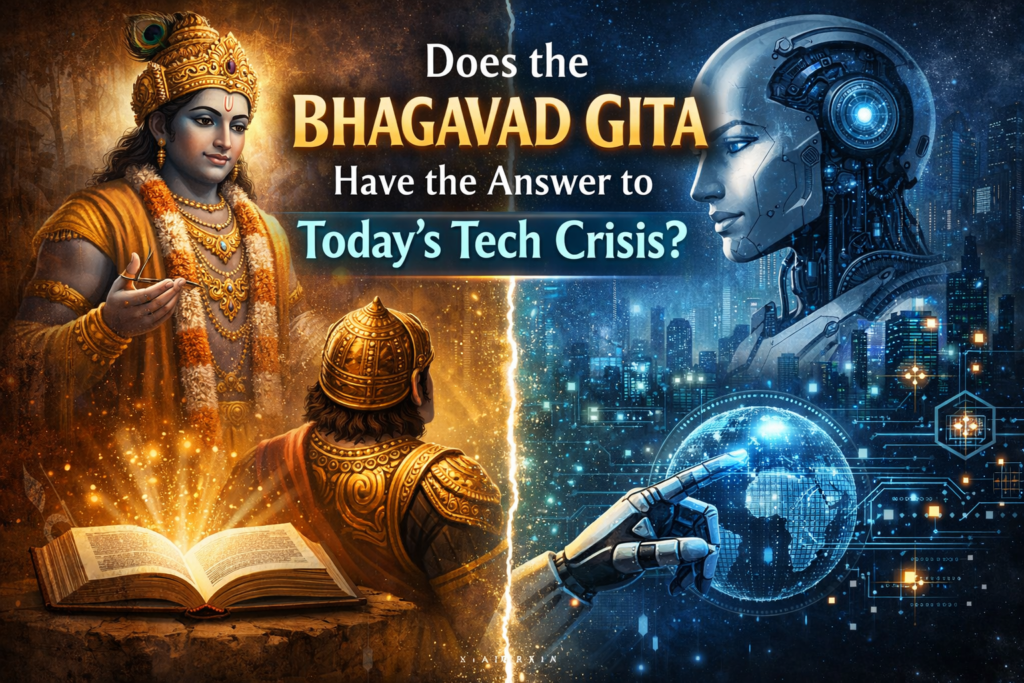
Artificial Intelligence is transforming the world faster than ever before. From self-driving cars and intelligent chatbots to medical diagnosis and cybersecurity, AI is revolutionizing nearly every aspect of human life. It can analyze massive datasets, predict outcomes, write code, create images, and even generate human-like conversations.
But amidst this extraordinary technological progress, an important question arises:
Can Artificial Intelligence distinguish between Dharma and Adharma?
Can it understand compassion beyond data?
Can it choose integrity over efficiency?
Can it sacrifice personal gain for the welfare of society?
The answer reveals why Bhagavad Gita Chapter 16 (Daivasura Sampad Vibhaga Yoga) remains remarkably relevant in the age of Artificial Intelligence.
Understanding Bhagavad Gita Chapter 16
Chapter 16 focuses on the two fundamental qualities that shape human life:
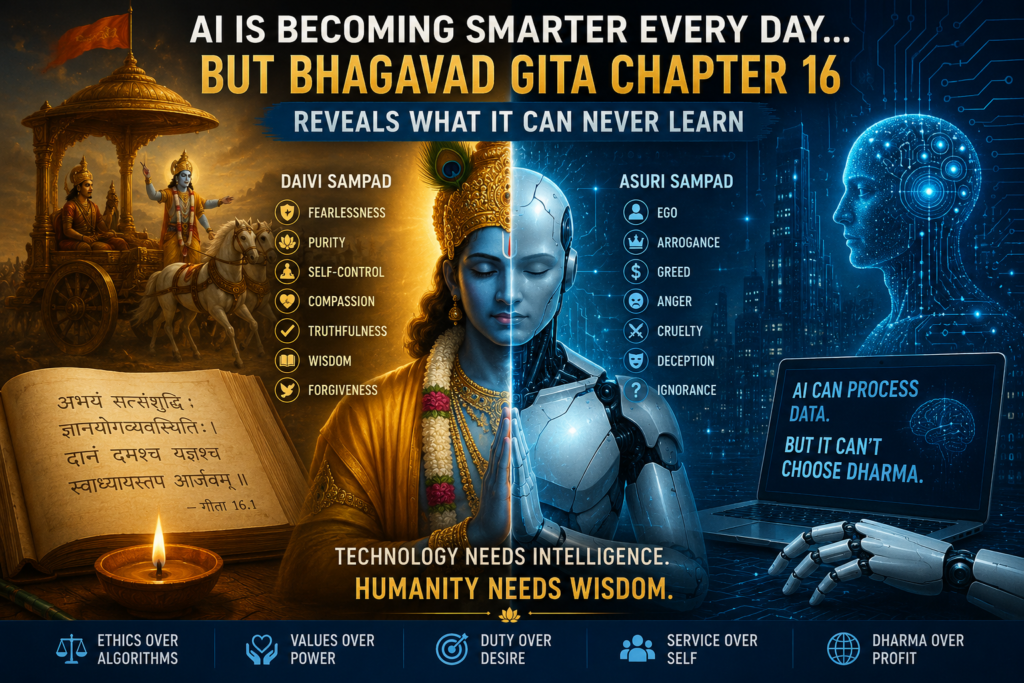
- Daivi Sampad (Divine Qualities) that lead to peace, wisdom, ethical living, and liberation.
- Asuri Sampad (Demoniac Qualities) that lead to arrogance, greed, anger, selfishness, conflict, and suffering.
Lord Krishna explains that every human being possesses both tendencies. Our thoughts, habits, and actions determine which qualities dominate our lives.
Divine qualities include fearlessness, humility, truthfulness, compassion, self-control, forgiveness, patience, simplicity, and respect for knowledge.
Demoniac qualities include pride, ego, greed, deception, anger, jealousy, violence, exploitation, and misuse of power.
Krishna’s message is timeless:
Human progress is measured not by power but by character.
Bhagavad Gita Chapter 16 Meets Artificial Intelligence
Artificial Intelligence can process information at incredible speed, but it cannot develop a conscience.
It can recognize faces.
It cannot recognize morality.
It can generate content.
It cannot understand responsibility.
It can optimize profits.
It cannot define justice.
This is where Bhagavad Gita Chapter 16 becomes highly relevant.
Technology reflects the values of its creators.
If AI is trained using biased data, it produces biased decisions.
Similarly, when humans are driven by greed, arrogance, and selfishness, they create technologies that amplify those same flaws.
Krishna teaches that intelligence without ethics ultimately becomes destructive.
The Real AI Challenge
Today, discussions about AI often focus on faster processors, larger language models, and advanced automation.
The Gita asks a more important question:
What kind of people are building these technologies?
If engineers, scientists, policymakers, and entrepreneurs embody truth, humility, compassion, and responsibility, technology becomes a force for global progress.
If they are driven by ego, greed, and power, even the most advanced innovations can harm society.
The future of AI depends not only on algorithms but also on human values.
Lessons for Engineers, Researchers, and Innovators
Bhagavad Gita Chapter 16 offers valuable guidance for every professional.
An engineer should build technology that serves humanity.
A software developer should prioritize security, privacy, and fairness.
A researcher should pursue innovation with honesty and integrity.
A leader should use technology for collective welfare rather than personal gain.
True innovation is not measured only by technical excellence but also by ethical responsibility.
Final Reflection
Artificial Intelligence may continue to evolve, but it will always depend on the wisdom of the people who create it.
Bhagavad Gita Chapter 16 reminds us that the greatest innovation is not building machines that think like humans—it is cultivating humans who think with compassion, integrity, humility, and Dharma.
As technology reshapes the external world, Krishna teaches us to strengthen the inner world.
Because the future will belong not merely to intelligent machines, but to wise human beings who combine knowledge with values and innovation with responsibility.
In the end, AI can imitate intelligence, but only humanity can choose Dharma.