A Question That Deserves an Honest Answer
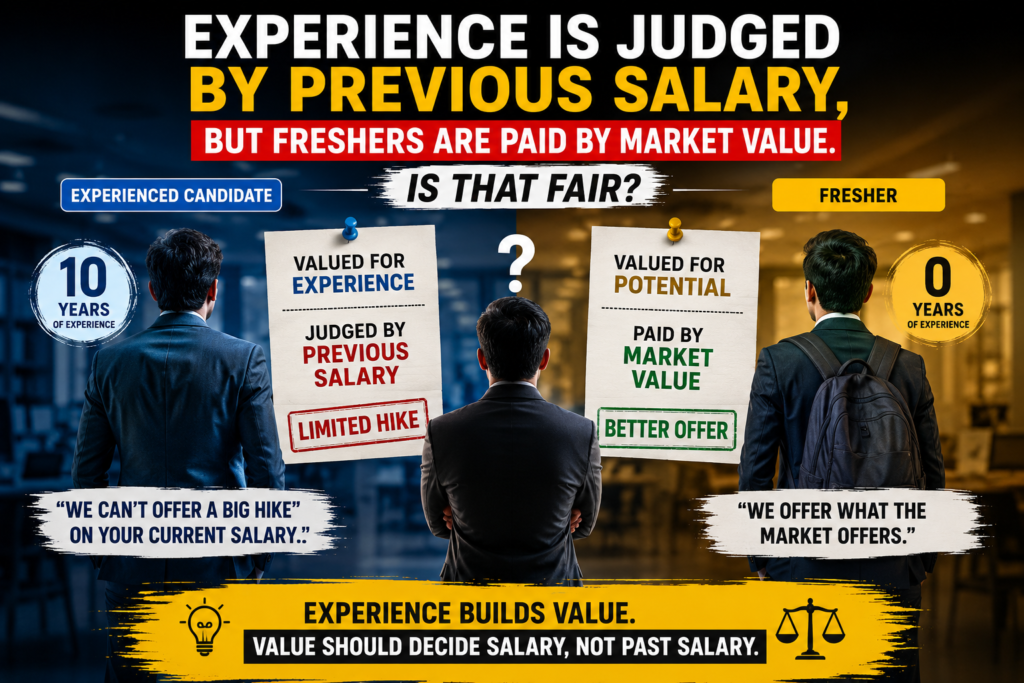
Imagine two candidates sitting in the same interview room.
One has spent years building expertise, handling responsibilities, solving problems, and contributing to organizational growth.
The other is just beginning their professional journey.
When the interview starts, the experienced candidate is praised for their knowledge and background. The fresher is appreciated for potential and enthusiasm.
But when salary discussions begin, something strange happens.
The fresher is offered compensation based on current market rates.
The experienced candidate is offered compensation based on previous salary.
Suddenly, years of experience seem less important than a number printed on an old payslip.
This raises a simple but powerful question:
If freshers are paid according to market value, why are experienced professionals often paid according to salary history?
The Previous Salary Trap
For many professionals, previous salary becomes a career ceiling.
An employer may genuinely appreciate a candidate’s experience, but the compensation discussion often revolves around a fixed percentage hike over the current package.
The logic sounds reasonable:
“We cannot justify a 70% or 100% hike.”
But this approach ignores an important reality.
What if the candidate was underpaid in the previous organization?
What if market conditions have changed?
What if their skills are now worth significantly more than before?
By focusing too heavily on salary history, organizations risk undervaluing talent.
Experience and Salary Are Not the Same Thing
Many people assume experience automatically translates into higher pay.
In reality, experience and salary often follow very different paths.
Some professionals spend years in organizations that offer limited increments.
Others switch jobs at the right time and see rapid salary growth.
As a result, two people with similar experience levels may have dramatically different salaries.
The market does not always reward experience equally.
Why Organizations Use Previous Salary
To be fair, employers have reasons for considering salary history.
It helps them:
- Control recruitment budgets.
- Maintain internal salary structures.
- Benchmark offers.
- Predict candidate expectations.
However, relying too heavily on salary history can create unintended consequences.
A candidate’s future earning potential becomes tied to decisions made by previous employers.
In effect, one organization’s compensation policy influences another organization’s hiring decision.
The Freshers vs Experience Debate Misses the Real Issue
This discussion is not about whether freshers deserve good salaries.
They do.
Competitive salaries help attract talented young professionals and encourage career growth.
The real issue is consistency.
If organizations trust the market when hiring freshers, they should also trust the market when evaluating experienced professionals.
The benchmark should be value, not merely salary history.
What Should Employers Evaluate Instead?
Rather than focusing primarily on previous salary, organizations should consider:
Skills and Expertise
Can the candidate solve problems effectively?
Proven Results
What measurable impact has the candidate delivered?
Leadership Potential
Can they mentor, guide, and improve team performance?
Industry Knowledge
How deep is their understanding of the field?
Future Contribution
What value can they create in the coming years?
These factors often provide a more accurate picture of a candidate’s worth than past compensation.
The Hidden Cost of Salary-Based Hiring
When experienced professionals feel undervalued, organizations may face consequences:
- Lower employee motivation.
- Higher turnover.
- Difficulty retaining skilled talent.
- Reduced organizational loyalty.
People stay where they feel respected.
And compensation is one of the clearest signals of respect in a professional environment.
The Future of Hiring Must Change
The workplace is evolving rapidly.
Skills become obsolete faster than ever.
New technologies emerge every year.
Organizations need talented people who can adapt, learn, and contribute.
To attract and retain such talent, hiring practices must evolve too.
A candidate’s previous salary should be one piece of information—not the deciding factor.
The focus should shift toward capability, contribution, and future impact.
Final Thoughts
Experience is not just time spent in a job.
It is knowledge gained through challenges.
It is wisdom developed through mistakes.
It is confidence built through responsibility.
And it is value created through years of effort.
If organizations truly value experience, then they must look beyond old salary figures and recognize the contribution that experienced professionals bring.
Because in the end, a person’s worth is not defined by yesterday’s payslip.
It is defined by what they can achieve today and tomorrow.
A Thought to Leave You With
A fresher is hired for potential.
An experienced professional is hired for proven capability.
Both deserve to be valued fairly.