Every morning, millions of people wake up and reach for their phones before they even get out of bed.
Notifications. Messages. News. Social media. Videos.
Before the day begins, attention has already been captured.
Technology has transformed how we learn, work, communicate, and live. It has given humanity unprecedented access to knowledge and opportunity.
Yet many people feel:
- constantly distracted
- mentally exhausted
- unable to focus
- trapped in endless scrolling
- busy but unfulfilled
This raises an important question:
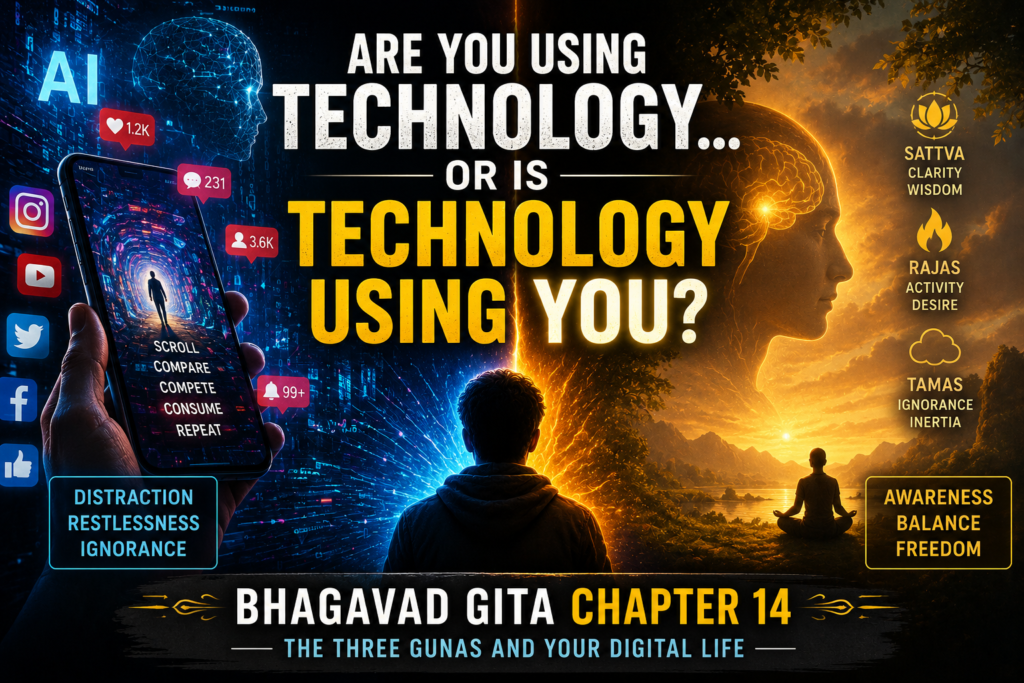
Are we controlling technology, or is technology controlling us?
Surprisingly, this question connects deeply with Chapter 14 of the Bhagavad Gita, known as Gunatraya Vibhaga Yoga — the Yoga of the Three Gunas.
In this chapter, Lord Krishna explains that human behavior is influenced by three fundamental qualities:
Sattva – Clarity and Wisdom
Sattva promotes learning, balance, awareness, discipline, and inner growth.
When technology is used to:
- learn new skills
- study
- build knowledge
- solve problems
- create meaningful work
it strengthens Sattva.
Rajas – Activity and Desire
Rajas creates ambition, competition, restlessness, and the constant desire for more.
Today, social media often fuels:
- comparison
- chasing followers
- online popularity
- endless productivity pressure
- fear of missing out
This is Rajas in action.
Tamas – Ignorance and Inertia
Tamas leads to confusion, laziness, procrastination, and lack of awareness.
Hours of mindless scrolling, binge-watching, digital addiction, and consuming content without purpose often strengthen Tamas.
The remarkable insight of Chapter 14 is this:
The same technology can create wisdom, ambition, or distraction.
The difference is not the device.
The difference is the state of mind using it.
A smartphone can:
- teach a new skill
- waste an entire evening
- inspire creativity
- destroy focus
The choice happens every day.
This is why Chapter 14 feels incredibly relevant in the age of AI and digital technology.
As technology becomes smarter, the most important question is no longer:
“How intelligent is the technology?”
Instead, it becomes:
“What kind of person is using it?”
Because the future will not be determined only by powerful AI.
It will be determined by whether humans use technology with wisdom, restlessness, or ignorance.
And perhaps that is the timeless lesson of Bhagavad Gita Chapter 14:
Technology shapes the world.
But character shapes how technology is used.
The real challenge of the digital age is not building smarter machines.
It is building wiser human beings.