Understanding Bhagavad Gita Chapter 15 in Today’s Technological Era
What if a scripture written thousands of years ago could explain the challenges of Artificial Intelligence, social media addiction, information overload, and the future of human consciousness?
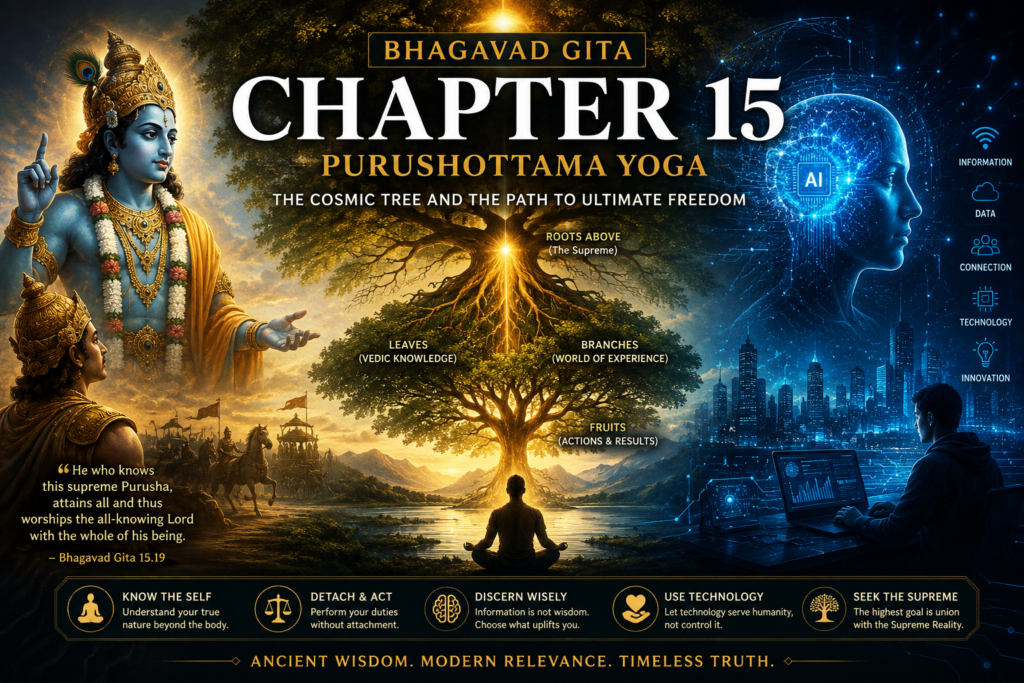
Bhagavad Gita Chapter 15, known as Purushottama Yoga, is one of the most profound chapters of the Gita. In this chapter, Lord Krishna presents a powerful metaphor—the Ashvattha Tree, an inverted tree whose roots are above and branches spread below. At first glance, it appears to be a spiritual concept, but when viewed through the lens of today’s digital age, it becomes surprisingly relevant.
The wisdom contained in this chapter offers insights not only into human existence but also into the technological world we are creating.
The Cosmic Tree and the Digital Universe
Krishna describes a vast tree with roots in the higher reality and branches extending into the material world. The branches represent worldly activities, desires, attachments, and experiences.
In today’s world, this image resembles the internet itself.
The modern digital ecosystem is also a giant interconnected network. Social media platforms, cloud computing systems, artificial intelligence models, blockchain networks, and global communication infrastructures form an invisible web connecting billions of people.
Every day, new branches are added through emerging technologies, applications, databases, and digital services.
Just as Krishna explains that individuals become entangled in the branches of the cosmic tree, modern humans often become trapped in endless digital consumption, notifications, online validation, and virtual identities.
The tree described in the Gita is no longer merely philosophical—it mirrors the reality of the connected digital age.
Information Is Not Wisdom
One of the greatest lessons of Chapter 15 is the distinction between external knowledge and inner wisdom.
Today, Artificial Intelligence can process massive amounts of information within seconds. Search engines can retrieve millions of results instantly. Generative AI can create articles, code, images, and videos.
Yet despite having more information than any previous generation, humanity continues to struggle with anxiety, stress, loneliness, ethical dilemmas, and social conflicts.
Why?
Because information and wisdom are not the same.
AI can generate answers, but it cannot provide genuine self-realization.
Algorithms can predict behavior, but they cannot understand the deeper purpose of human existence.
Krishna reminds us that true wisdom emerges when knowledge is combined with awareness, self-control, and understanding of the self.
Artificial Intelligence and Human Consciousness
One of the most fascinating teachings of Chapter 15 concerns the nature of consciousness.
Krishna explains that the individual soul is eternal and distinct from the physical body. The body changes, the mind changes, and circumstances change, but the conscious self remains.
Modern AI systems can recognize patterns, learn from data, and perform sophisticated tasks. However, they operate through computation rather than consciousness.
An AI model can simulate emotions.
It cannot experience them.
It can generate spiritual content.
It cannot attain spiritual awareness.
It can discuss compassion.
It cannot genuinely feel compassion.
This distinction is becoming increasingly important as society debates whether machines can ever become truly conscious.
The Gita suggests that consciousness is not merely a computational process but a deeper reality connected to the self.
The Problem of Digital Attachment
Krishna advises Arjuna to cut down the cosmic tree using the weapon of detachment.
This teaching is extraordinarily relevant in the age of smartphones and social media.
Modern technology companies compete for human attention. Every notification, recommendation, and personalized feed is designed to increase engagement.
The result is a culture of constant distraction.
Many people check their phones hundreds of times each day. They seek validation through likes, shares, and online recognition.
The Gita teaches that attachment creates dependence and suffering.
Technology itself is not the problem.
Attachment to technology is.
Chapter 15 encourages individuals to use technology consciously rather than becoming controlled by it.
The Age of AI Requires the Principle of Dharma
Artificial Intelligence is transforming healthcare, education, governance, transportation, finance, and communication.
However, AI also raises critical ethical questions.
Who is responsible when an AI system makes a harmful decision?
How should personal data be protected?
Can algorithms be fair and unbiased?
Should machines influence legal, medical, or military decisions?
The Bhagavad Gita provides a timeless answer through the concept of Dharma.
Dharma emphasizes responsibility, ethical action, and concern for collective welfare.
As AI becomes more powerful, technological progress must be guided not only by efficiency but also by ethics.
The future of innovation depends not simply on what technology can do, but on what it should do.
Human Intelligence Versus Artificial Intelligence
Chapter 15 highlights three dimensions of reality:
- The material world.
- The individual self.
- The Supreme Reality.
Modern civilization has made tremendous progress in understanding the material world.
Artificial Intelligence extends that capability further.
Yet humanity still faces challenges related to meaning, purpose, morality, and consciousness.
The Gita teaches that technological advancement alone cannot solve these deeper questions.
Human intelligence creates technology.
Wisdom determines how technology is used.
Without wisdom, innovation can become destructive.
With wisdom, innovation becomes a force for human flourishing.
The Future Belongs to Wise Innovators
The most valuable lesson from Chapter 15 for students, researchers, engineers, entrepreneurs, and policymakers is clear:
The future does not belong merely to those who build intelligent machines.
It belongs to those who combine intelligence with wisdom, innovation with ethics, and progress with responsibility.
Artificial Intelligence may transform industries.
But only human wisdom can ensure that transformation serves humanity.
Final Reflection
Bhagavad Gita Chapter 15 is far more than a spiritual discourse. It is a guide for navigating an increasingly complex technological civilization.
The inverted cosmic tree described by Krishna reflects the interconnected digital world we inhabit today. The chapter warns against attachment, highlights the importance of self-awareness, and reminds us that consciousness cannot be reduced to computation.
As Artificial Intelligence reshapes the external world, the teachings of the Bhagavad Gita invite us to cultivate the inner intelligence that guides ethical action, responsible innovation, and meaningful progress.
The greatest challenge of the twenty-first century is not creating smarter machines.
It is creating wiser human beings.