
The Future of Wireless Networks Won’t Be Built by Humans Alone. AI and Quantum Intelligence Are Taking Over.
Imagine a wireless network that can:
Detect problems before they occur
Heal itself automatically
Optimize performance in real time
Secure billions of IoT devices without human intervention
Learn and adapt using quantum computing
This is no longer science fiction.
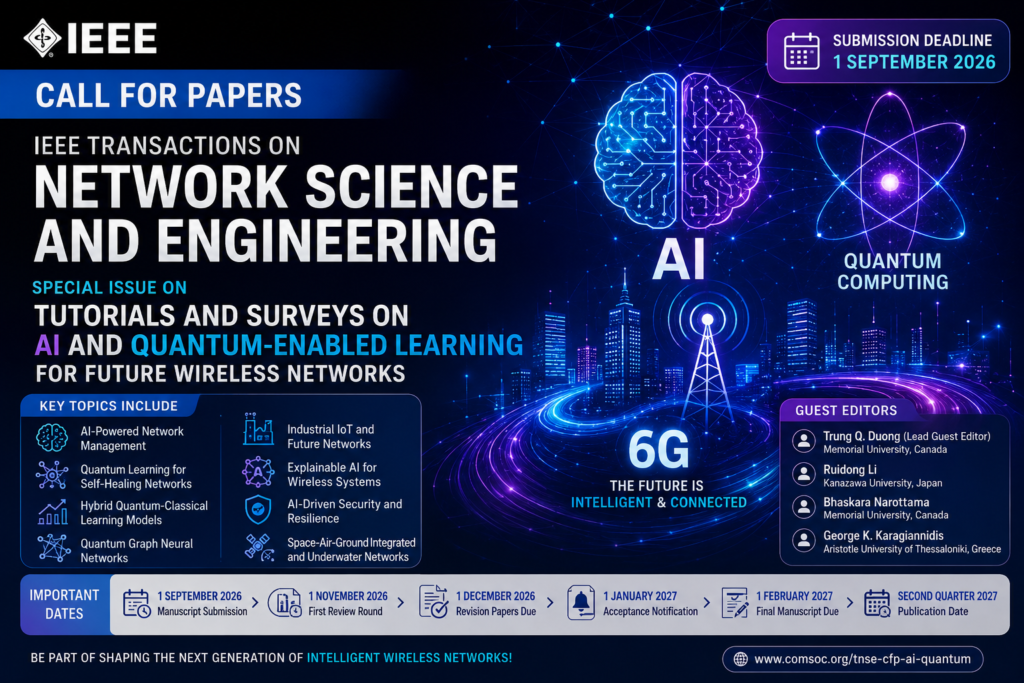
The prestigious IEEE has announced a special issue in IEEE Transactions on Network Science and Engineering focused on:
“Tutorials and Surveys on AI and Quantum-enabled Learning for Future Wireless Networks”.
For researchers, PhD scholars, professors, and industry innovators, this represents one of the most exciting publication opportunities in emerging networking technologies.
Why This Special Issue Matters
The world is rapidly moving toward:
- 6G communication
- Autonomous networks
- Industrial IoT
- Smart healthcare systems
- Connected vehicles
- Edge and fog computing
- AI-native communication infrastructures
Traditional networking approaches are struggling to keep up with the complexity of future wireless ecosystems.
Researchers are increasingly exploring the combination of:
- Artificial Intelligence (AI)
- Machine Learning (ML)
- Quantum Computing
- Quantum Machine Learning
- Hybrid Quantum-Classical Systems
to create networks that are more intelligent, resilient, and efficient.
Key Research Areas Invited
This special issue welcomes tutorial and survey papers covering topics such as:
AI-Powered Network Management
Using intelligent algorithms for automated network optimization and orchestration.
Quantum Learning for Self-Healing Networks
Networks capable of identifying failures and recovering automatically.
Hybrid Quantum-Classical Learning Models
Combining classical machine learning with quantum computing techniques.
Quantum Graph Neural Networks
Advanced AI models designed to optimize complex network topologies.
Industrial IoT Networks
Next-generation learning frameworks for massive industrial deployments.
Explainable AI (XAI)
Making AI-driven network decisions transparent and trustworthy.
AI-Driven Cybersecurity
Protecting future communication systems against sophisticated attacks.
Space-Air-Ground Integrated Networks
Optimizing communication across satellites, drones, terrestrial systems, and underwater networks.
Why Researchers Should Pay Attention
The networking industry is entering a transformational era.
Experts believe future 6G ecosystems will rely heavily on AI-driven automation and intelligent resource management. Researchers worldwide are already exploring AI-enabled wireless architectures and autonomous networking models to address increasing complexity and performance demands.
This special issue provides an opportunity to contribute to a rapidly growing field that could define communication technologies for the next decade.
Important Dates
| Event | Date |
|---|---|
| Manuscript Submission | 1 September 2026 |
| First Review Round | 1 November 2026 |
| Revision Submission | 1 December 2026 |
| Acceptance Notification | 1 January 2027 |
| Final Manuscript Due | 1 February 2027 |
| Publication | Second Quarter 2027 |
Guest Editors
The special issue is led by internationally recognized researchers:
- Trung Q. Duong
- Ruidong Li
- Bhaskara Narottama
- George K. Karagiannidis
What This Means for PhD Scholars
If your research involves:
- Blockchain and IoT
- AI for Healthcare
- Wireless Communication
- 6G Technologies
- Quantum Computing
- Machine Learning
- Network Security
- Edge Computing
then this special issue deserves your attention.
Survey and tutorial papers often become highly cited references because they help shape the direction of future research.
Final Thoughts
The next generation of wireless networks will not simply be faster.
They will be intelligent, adaptive, autonomous, and quantum-enhanced.
As AI and quantum computing continue to converge, researchers have a unique opportunity to contribute to technologies that could redefine global communication infrastructure.
The future of networking is no longer just connected.
It is becoming self-learning.