Publishing in a Scopus-indexed journal is often a key requirement for PhD completion, faculty promotions, research grants, and academic recognition. However, many researchers make the mistake of checking a journal’s indexing status only once and assuming it remains indexed forever.
The reality is different.
Scopus continuously reviews journals through its Content Selection and Advisory Board (CSAB). If a journal fails to maintain the required quality standards, it can be discontinued from the Scopus database.
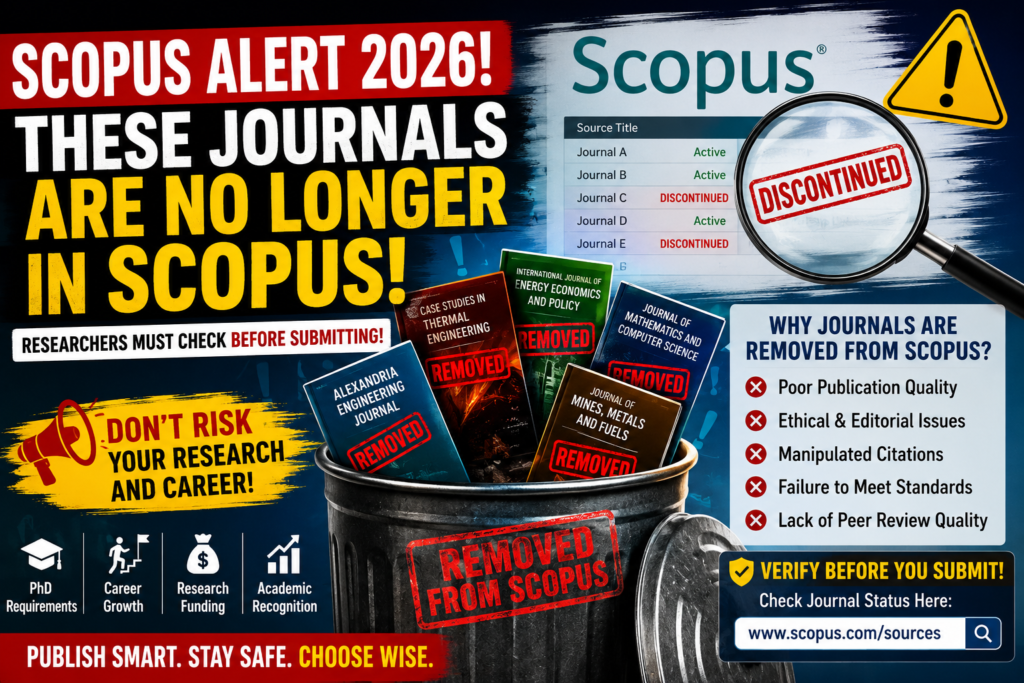
Recent updates have shown that several journals have been removed from Scopus indexing, making it essential for researchers to verify a journal’s current status before manuscript submission.
Why Does Scopus Remove Journals?
Scopus may discontinue journals due to:
- Poor publication quality
- Editorial and peer-review concerns
- Publication ethics issues
- Excessive self-citations
- Manipulated citation practices
- Failure to maintain international publishing standards
A discontinued journal may still display previously indexed articles, but newly published articles after discontinuation may not be indexed in Scopus.
Recently Reported Discontinued Scopus Journals (2026)
| S. No. | Journal Name |
|---|---|
| 1 | Alexandria Engineering Journal |
| 2 | Case Studies in Thermal Engineering |
| 3 | Current Research in Environmental and Applied Mycology |
| 4 | Educational Process: International Journal |
| 5 | Financial and Credit Activity: Problems of Theory and Practice |
| 6 | International Journal of Accounting and Economics Studies |
| 7 | International Journal of Energy Economics and Policy |
| 8 | Journal of Mathematics and Computer Science |
| 9 | Journal of Mines, Metals and Fuels |
| 10 | Perinatal Journal |
| 11 | Premier Journal of Science |
| 12 | Reliability: Theory and Applications |
Note: Researchers should always verify the latest status directly via the official Scopus Source Search, as indexing status can change over time.
Why This Matters for Researchers
Publishing in a discontinued journal can affect:
| Academic Activity | Possible Impact |
|---|---|
| PhD Thesis Submission | Publication may not fulfill institutional requirements |
| Faculty Promotion | Journal may not be accepted for promotion criteria |
| Research Grants | Reduced academic credibility |
| API/Performance Scores | May impact research evaluation metrics |
| University Rankings | Lower contribution to institutional research output |
For this reason, researchers should never rely solely on claims made on a journal’s website.
How to Verify a Journal Before Submission
Before submitting your manuscript, follow these steps:
| Step | Action |
|---|---|
| 1 | Visit the official Scopus Source Search |
| 2 | Search using the Journal Title |
| 3 | Verify the ISSN number |
| 4 | Check the journal’s current indexing status |
| 5 | Review publisher information |
| 6 | Confirm the journal is actively indexed |
Official Scopus Source Search:
https://www.scopus.com/sources
Red Flags Researchers Should Watch For
If a journal shows any of the following signs, investigate carefully before submission:
| Warning Sign | Risk Level |
|---|---|
| Unrealistically Fast Acceptance | High |
| Guaranteed Publication | High |
| Poor Website Quality | Medium |
| Missing Editorial Board Information | High |
| Fake Impact Factor Claims | Very High |
| Conflicting Indexing Information | High |
| Excessive Publication Charges Without Transparency | Medium |
Key Lesson for PhD Scholars and Faculty Members
The biggest mistake in academic publishing is assuming that a journal remains indexed simply because it was indexed in the past.
A journal that was Scopus-indexed last year may no longer be indexed today.
Therefore, every researcher should adopt a simple rule:
“Verify First, Submit Later.”
Spending five minutes checking a journal’s status can save months of effort, publication delays, and academic complications.