We live in a time where people constantly feel pressure to appear perfect.
Social media platforms are filled with carefully edited photos, achievements, luxury lifestyles, travel pictures, success stories, and public validation. Every day, millions of people upload moments designed to look impressive in front of others.
Slowly, a new kind of pressure has emerged in modern life:
the pressure to appear successful all the time.
Many people no longer just live experiences.
They feel the need to display them.
This has created a culture where appearance often becomes more important than reality.
People compare their real lives with the polished digital image of others and begin feeling:
- insecure
- unsuccessful
- emotionally exhausted
- dissatisfied with themselves
Even though most online content only shows selective moments.
This is one of the biggest psychological effects of the social media age.
And surprisingly, the wisdom of Chapter 11 of the Bhagavad Gita connects deeply with this modern problem.
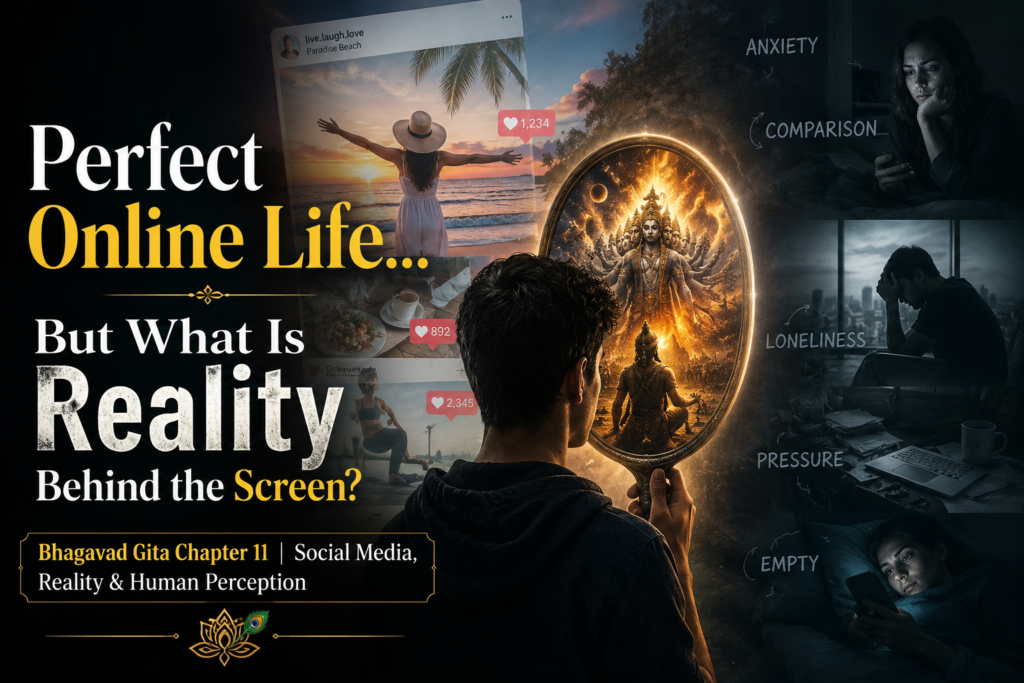
Chapter 11, known as Vishwarupa Darshana Yoga, is the chapter where Lord Krishna reveals his universal form to Arjuna.
This moment is powerful because Arjuna suddenly realizes something important:
reality is far greater than human perception.
Until that moment, Arjuna had only seen Krishna in a limited human form. But when the universal form is revealed, Arjuna understands how small human understanding can be compared to the larger truth.
This idea feels incredibly relevant in today’s digital world.
Because social media often shows only limited versions of reality.
People see:
- edited success
- filtered happiness
- curated lifestyles
- public achievements
But rarely see:
- failure
- anxiety
- loneliness
- emotional struggle
- uncertainty
As a result, many individuals begin comparing their full reality with someone else’s carefully managed online image.
And that comparison quietly damages self-worth.
Technology itself is not the problem.
The real issue is how digital culture encourages people to confuse appearance with reality.
This is where the wisdom of Bhagavad Gita Chapter 11 becomes deeply meaningful.
The chapter reminds us that reality is always bigger than what is immediately visible.
What people display publicly is often only a very small part of their actual life.
Yet modern digital culture constantly encourages people to seek validation through visibility.
People feel pressure to:
- look successful
- appear happy
- impress others
- maintain an image
Even when internally they may feel exhausted.
This creates emotional imbalance because maintaining an online image can slowly disconnect people from their authentic self.
Chapter 11 teaches something very important for the modern age:
truth is more important than appearance.
Arjuna’s transformation happens when he moves beyond limited perception and sees a deeper reality.
Similarly, modern society often needs to move beyond digital appearances and reconnect with authenticity.
Because no one’s life is as perfect as social media makes it appear.
Every person experiences:
- struggle
- confusion
- fear
- emotional pressure
- uncertainty
But digital platforms rarely show those realities honestly.
This creates unrealistic expectations that affect mental well-being, confidence, and self-worth.
That is why many people today feel emotionally tired despite constantly consuming “perfect” content online.
The message of Vishwarupa Darshana Yoga reminds us that human understanding becomes distorted when it focuses only on surface-level appearances.
Real life is deeper than curated images.
Real happiness is deeper than online validation.
And real confidence comes from authenticity—not performance.
This is why the message of Bhagavad Gita Chapter 11 feels so relevant today.
It reminds us that truth matters more than image, and authenticity matters more than digital perfection.
In the end, social media may show what people want others to see.
But inner peace comes from accepting who we truly are beyond appearances.
And perhaps that is one of the most important lessons Chapter 11 offers for the digital generation.