Never before in history have people been so connected—yet so emotionally dependent on attention.
Today, a simple notification can change someone’s mood.
A post getting fewer likes can create disappointment.
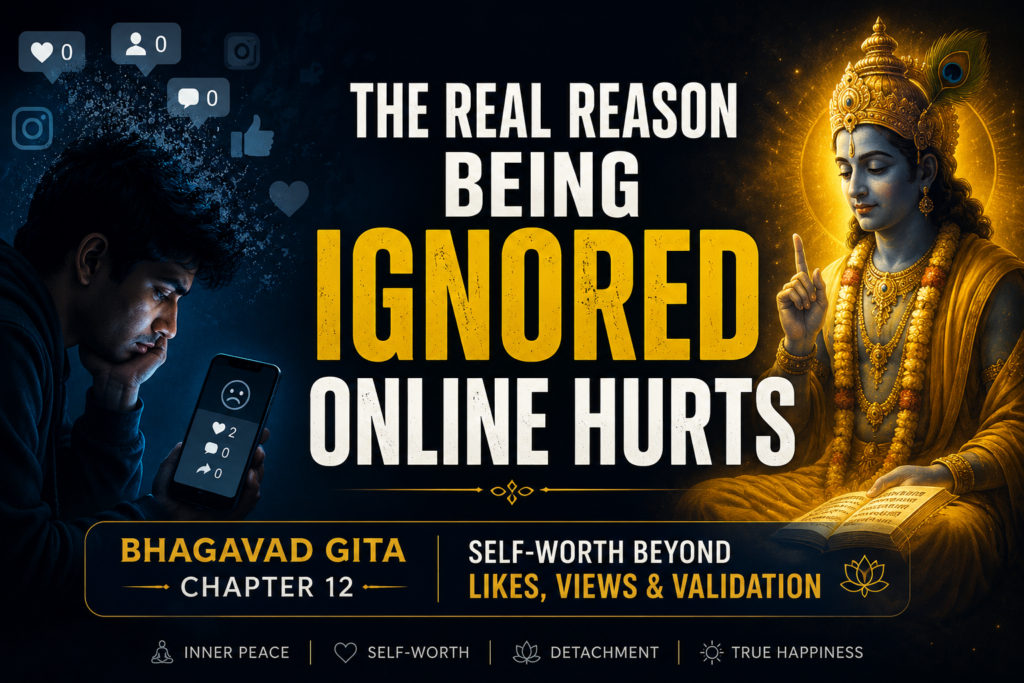
Being ignored online can quietly affect confidence, self-worth, and even mental peace.
This is the reality of modern digital life.
Social media platforms have transformed attention into emotional validation.
People no longer just share moments.
Many now unconsciously seek reassurance through:
- likes
- comments
- followers
- views
- public reactions
Slowly, online approval begins influencing how people feel about themselves.
And this raises an important question:
Why has digital validation become so emotionally powerful?
Surprisingly, the wisdom of Chapter 12 of the Bhagavad Gita offers a deeply relevant answer.
Chapter 12, known as Bhakti Yoga, focuses on emotional balance, inner stability, humility, and genuine self-connection. In this chapter, Lord Krishna explains the qualities of a person who remains peaceful and emotionally grounded instead of constantly depending on external approval.
This message feels incredibly important in today’s social media-driven world.
Because modern digital culture constantly rewards visibility.
The more attention people receive online, the more valuable they often feel.
But this creates a hidden emotional problem:
self-worth slowly becomes dependent on public reaction.
And public reaction is unstable.
Algorithms change.
Trends change.
Online attention changes every day.
One moment people feel noticed.
The next moment they feel invisible.
This emotional instability is becoming increasingly common in the digital generation.
Many people today constantly check their phones not because they need information—
but because they are unconsciously searching for validation.
This is why social media can sometimes create:
- anxiety
- comparison
- emotional exhaustion
- insecurity
- fear of being ignored
Technology itself is not the real problem.
The deeper challenge is emotional dependence on external attention.
This is where the timeless wisdom of Bhagavad Gita Chapter 12 becomes deeply meaningful.
Krishna explains that true peace comes from inner emotional stability—not from constantly seeking approval from the outside world.
This does not mean people should avoid social media.
It means online attention should not control emotional well-being.
That distinction is extremely important.
Because when happiness depends entirely on public attention, peace becomes temporary.
A viral moment creates excitement for a short time.
But the need for more validation quickly returns.
This creates an endless cycle where people constantly seek attention but rarely feel fully satisfied.
Chapter 12 offers a completely different perspective.
It teaches that emotional strength grows when a person remains connected to their inner values instead of becoming emotionally controlled by external reactions.
This lesson has become incredibly relevant today because many people appear confident online while privately struggling with insecurity and emotional pressure.
Social media often rewards performance.
But inner peace comes from authenticity.
That is why many individuals continue chasing visibility while still feeling emotionally restless.
The more self-worth depends on digital validation, the more fragile emotional balance becomes.
And perhaps this is the most important lesson Bhagavad Gita Chapter 12 offers for the modern world:
A person who constantly needs validation from others may slowly lose connection with themselves.
In the end, attention from the world may feel powerful temporarily.
But lasting peace begins when self-worth no longer depends on being constantly noticed.
That is the timeless wisdom of Bhakti Yoga.
And in today’s digital generation, that wisdom may be more important than ever before.