
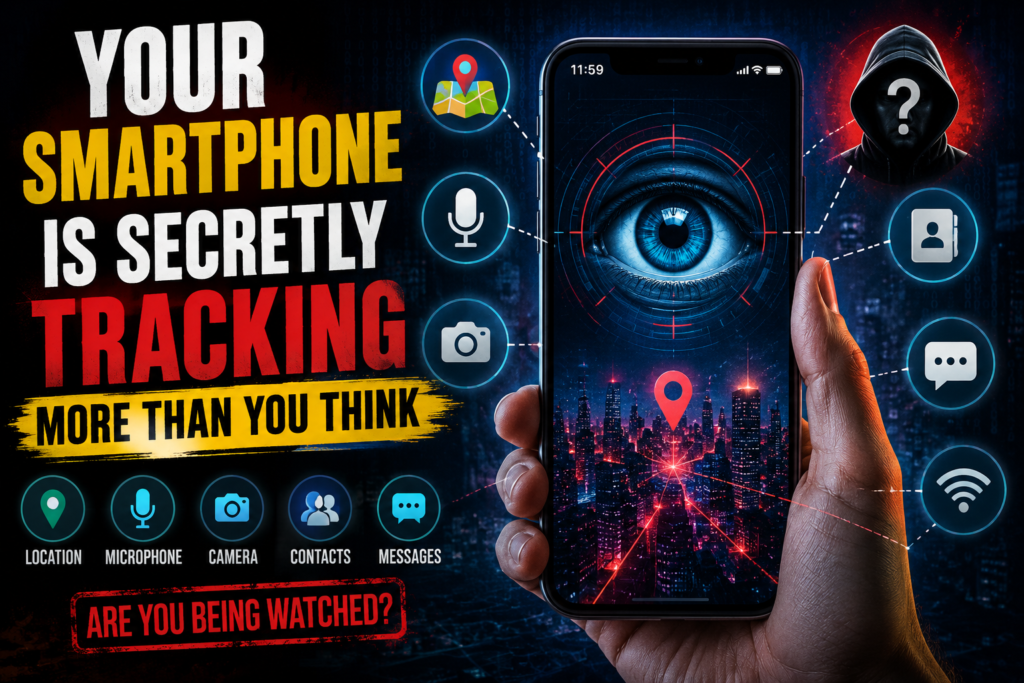
Your smartphone wakes you up in the morning, tracks your fitness, remembers your favorite restaurants, suggests videos, listens to voice commands, and even predicts where you may go next.
But what if the device you trust the most is also silently collecting more information about you than you ever imagined?
From location tracking and microphone access to app monitoring and advertising profiles, modern smartphones have become powerful data collection machines.
And most users have absolutely no idea how much information is being gathered every single day.
Your Phone Knows Where You Are Almost All The Time
One of the biggest privacy concerns is location tracking.
Many apps continue collecting location data even when they are not actively being used. Navigation apps, food delivery apps, weather apps, social media platforms, and even shopping apps may request constant access to your location.
Tech experts say this data helps companies:
- Analyze user behavior
- Deliver targeted advertisements
- Predict movement patterns
- Improve recommendation systems
Google itself explains how location history works across devices and apps.
Source: https://support.google.com/accounts/answer/3118687
According to cybersecurity researchers, smartphones can build detailed movement profiles based on repeated location tracking.
Source: https://consumer.ftc.gov/articles/how-protect-your-privacy-apps
Apps May Be Watching More Than You Think
Most users quickly press “Allow” when apps request permissions.
But those permissions can include:
- Camera access
- Microphone access
- Contacts
- Messages
- Call logs
- Files and photos
- Background activity tracking
Some apps collect data not only for functionality but also for advertising and analytics purposes.
Apple’s App Privacy Reports and Android privacy dashboards now allow users to see how often apps access sensitive data.
Source: https://support.apple.com/en-in/102188
Source: https://support.google.com/android/answer/11416242
Your Search History Is Extremely Valuable
Every search you make helps technology companies understand your interests, habits, fears, shopping behavior, and lifestyle.
Search engines and apps use this information to personalize:
- Advertisements
- Recommendations
- Content feeds
- Product suggestions
A report from Pew Research found many users are concerned about how companies collect and use personal data online.
Is Your Phone Listening To You?
This is one of the internet’s biggest privacy debates.
Many users believe smartphones listen to conversations because advertisements sometimes appear related to things they recently discussed.
Major companies have repeatedly denied secretly recording conversations without permission. However, voice assistants like Google Assistant, Siri, and Alexa do process voice commands when activated.
Experts say targeted advertising is often powered by:
- Search history
- Browsing patterns
- App behavior
- Location history
- Online activity
Still, cybersecurity researchers continue encouraging users to carefully manage microphone permissions.
Source: https://consumer.ftc.gov/articles/how-protect-your-privacy-online
Free Apps Are Often Not Really Free
Many free applications generate revenue by collecting user data.
This information may include:
- Device identifiers
- Usage habits
- Interests
- Approximate location
- Shopping activity
The collected data can then be used for advertising systems and analytics platforms.
A report by Mozilla highlighted growing concerns around privacy practices in mobile applications.
Source: https://foundation.mozilla.org/en/privacynotincluded/
Public Wi-Fi Can Also Be Dangerous
Using free Wi-Fi at airports, cafes, hotels, and public places may expose users to cybersecurity risks.
Hackers can sometimes create fake Wi-Fi networks or intercept unprotected connections.
Cybersecurity agencies recommend:
- Avoiding sensitive banking activity on public Wi-Fi
- Using trusted networks
- Enabling two-factor authentication
- Keeping devices updated
Source: https://www.cisa.gov/resources-tools/resources/using-public-wi-fi-networks-safely
Why Companies Collect So Much Data
Data has become one of the world’s most valuable digital resources.
Technology companies use collected information to:
- Improve services
- Train AI systems
- Deliver personalized ads
- Increase user engagement
- Predict consumer behavior
Modern recommendation algorithms on social media platforms heavily rely on user activity and behavioral data.
How To Protect Your Privacy
You may never completely stop digital tracking, but experts recommend reducing unnecessary data collection by following simple privacy practices:
1. Review App Permissions
Disable permissions that apps do not truly need.
2. Turn Off Location Access
Use “Only While Using The App” instead of “Always.”
3. Delete Unused Apps
Unused applications may still collect background data.
4. Use Strong Passwords
Enable two-factor authentication wherever possible.
5. Keep Your Phone Updated
Security updates help protect against vulnerabilities and cyberattacks.
6. Check Privacy Dashboards
Both Android and iPhone now provide tools showing which apps access sensitive data.
The Real Question Nobody Is Asking
Smartphones have made modern life faster, smarter, and more connected.
But in exchange for convenience, users may be giving away enormous amounts of personal information every single day.
Your location, habits, interests, searches, movements, and behavior patterns are all becoming part of the digital economy.
The real question is no longer whether smartphones collect data.
The real question is:
How much privacy are people willing to sacrifice for convenience?
Final Thoughts
Your smartphone may be one of the most powerful technologies ever created.
But it may also be one of the biggest privacy compromises in human history.
As artificial intelligence, smart devices, and digital advertising continue evolving, online privacy is becoming more important than ever before.
Understanding how smartphones collect and use data is no longer optional.
It is becoming essential.