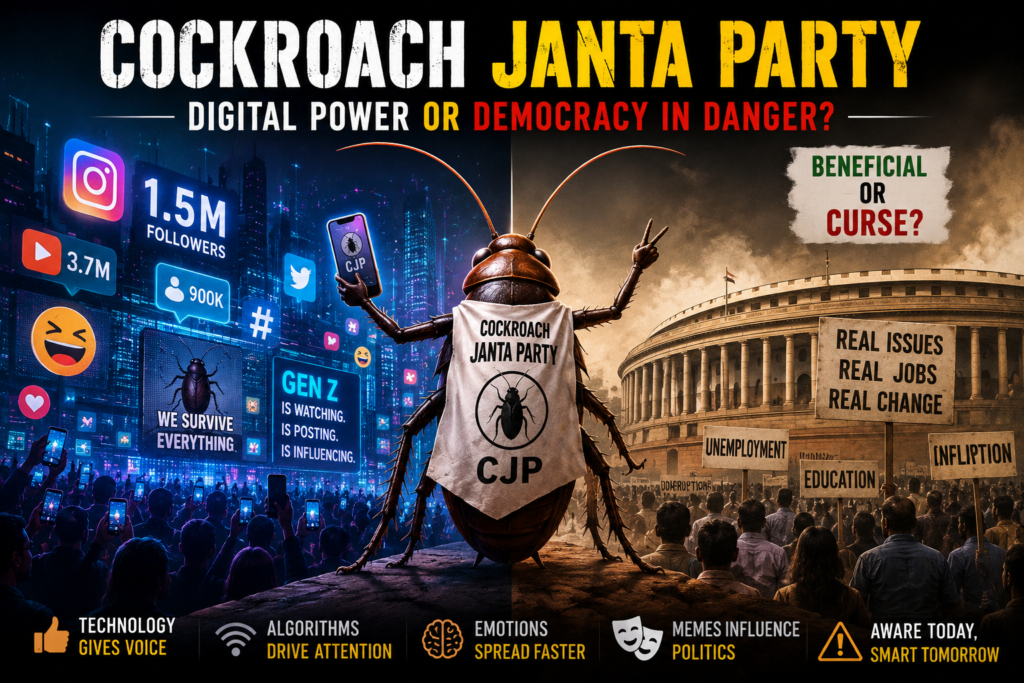
A meme.
A cockroach logo.
A flood of Gen Z followers.
And suddenly, India had one of its most talked-about internet-driven political movements.
What began as satire through the “Cockroach Janta Party” (CJP) quickly transformed into a viral digital phenomenon across social media platforms. Within days, the movement attracted massive online attention, especially among young Indians frustrated with unemployment, rising pressure, and political disconnect.
But this story is not really about a meme party.
It is about something much bigger:
Has technology become powerful enough to shape politics through emotions, algorithms, and viral trends instead of real discussion?
What Exactly Is the “Cockroach Janta Party”?
The movement emerged after controversial comments comparing unemployed youth to “cockroaches.” Instead of rejecting the label, many young users online embraced it ironically and turned it into a symbol of frustration and internet rebellion.
According to Reuters, the movement rapidly gained traction online and became closely associated with Gen Z dissatisfaction around jobs, economic stress, and feeling unheard.
Official Reuters Report:
Reuters – India’s Cockroach Group Goes Viral
The movement spread primarily through:
- Instagram reels
- memes
- hashtags
- edits
- online communities
- viral comment culture
This was not traditional politics.
This was internet politics.
The Followers Explosion Nobody Expected
One of the biggest reasons this movement shocked the internet was the speed at which its followers increased.
According to Reuters, the Cockroach Janta Party’s Instagram account crossed approximately 1.3 million followers within days, rapidly becoming one of India’s most viral internet-driven political satire movements.
Official Reuters Source:
Reuters Official Coverage
This revealed something extremely important:
Today, a movement does not always need:
- offices
- rallies
- banners
- or traditional political infrastructure
Sometimes:
a viral algorithm is enough.
The Real Story Is Technology
The Cockroach Janta Party became viral because modern technology rewards:
- emotional content
- humor
- outrage
- relatability
- controversy
Social media algorithms push highly engaging content faster than nuanced debate.
That means:
a meme can now spread faster than a political speech.
And this changes everything.
From Street Protests to Meme Protests
Earlier generations protested physically.
Today’s digital generation often protests through:
- reels
- stories
- memes
- trends
- comments
- viral posts
Many Gen Z users may never attend political rallies.
Yet they influence:
- narratives
- online discussions
- public perception
- internet culture
This is one of the biggest shifts in modern democracy.
Technology has created a new type of political participation:
attention-based influence.
But Is This a Blessing or a Curse?
That is where the debate becomes serious.
Technology as a Blessing
Social media gives young people:
- visibility
- expression
- community
- participation
- awareness
People who once had no public voice can now influence national conversations.
Movements can grow rapidly without traditional media support.
Technology as a Curse
At the same time, technology also:
- spreads misinformation quickly
- rewards emotional reactions
- encourages shallow engagement
- creates echo chambers
- turns serious issues into trends
Millions of followers do not automatically mean:
- policy understanding
- governance ability
- real-world organization
- democratic depth
That is the dangerous illusion of internet popularity.
The “Follower Democracy” Era
One of the most fascinating parts of this movement is that many followers may not even be eligible voters.
Still, they influence:
- conversations
- online narratives
- media attention
- digital culture
This reveals a new reality:
In the internet age, followers can sometimes become more visible than voters.
And that changes how political influence works.
Why Gen Z Connected With It
According to Reuters and multiple analyses, many young Indians connected emotionally with the movement because it reflected:
- unemployment concerns
- rising competition
- exam pressure
- economic uncertainty
- frustration with institutions
- feeling politically unheard
India has one of the world’s largest youth populations, and social media has become the fastest emotional outlet for this generation.
Sometimes memes become popular not because people love jokes—
but because people feel ignored.
Is Meme Politics the Future?
Possibly.
Across the world, internet culture increasingly shapes:
- elections
- public opinion
- political branding
- youth participation
- digital activism
Memes are no longer just entertainment.
They are now communication tools.
And political movements understand something very important:
Whoever controls attention online often controls the national conversation.
The Bigger Question India Should Ask
The Cockroach Janta Party itself may fade away.
But the deeper issue will remain:
Why are so many young people connecting emotionally with satire instead of traditional politics?
Maybe because:
- trust is declining,
- frustration is increasing,
- and technology has become the easiest place to express anger publicly.
That is the real lesson behind this viral movement.
Final Thoughts
The rise of the Cockroach Janta Party shows how dramatically technology has transformed modern politics.
Earlier:
- speeches created influence.
Today:
- algorithms create influence.
Earlier:
- rallies shaped momentum.
Today:
- memes shape momentum.
Technology can strengthen democracy by giving people a voice.
But if emotions become stronger than information, technology can also weaken critical thinking.
That is why the real debate is not about cockroaches.
It is about the future of digital society itself.
And perhaps the biggest question is:
Are we building informed citizens — or only viral audiences?