
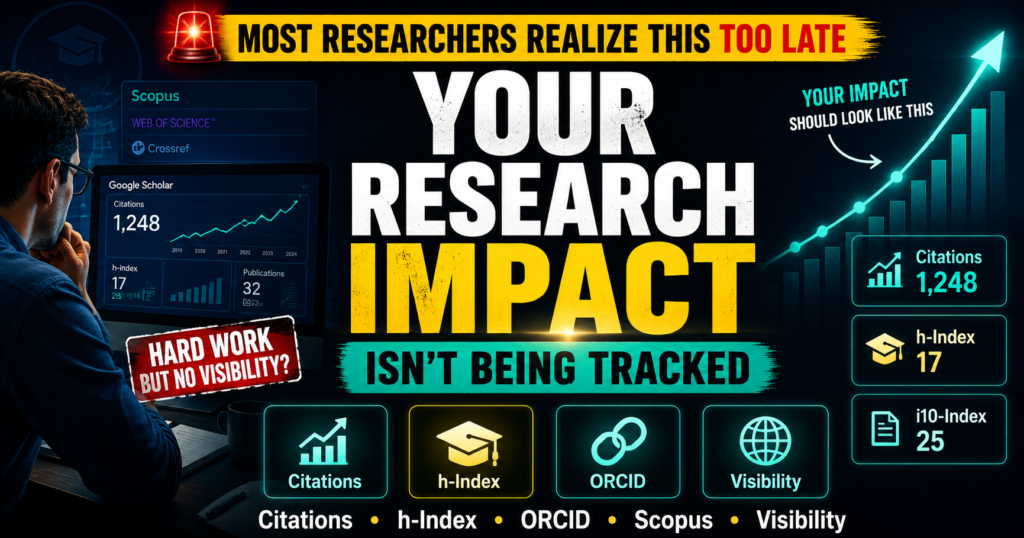
You spent months — sometimes years — writing papers, doing experiments, publishing research, and contributing to knowledge.
But here’s the reality many researchers discover too late:
Publishing a paper is no longer enough.
If your research is not properly tracked, indexed, visible, and connected across platforms, a large part of your academic impact can remain hidden.
Today, universities, recruiters, research organizations, and funding agencies increasingly evaluate researchers not only by publications — but also by:
✔ Citation growth
✔ Research visibility
✔ h-index
✔ Online academic presence
✔ Author identity consistency
✔ International discoverability
That’s why every student, PhD scholar, and researcher should build a proper Research Impact Tracking System from the beginning.
6 Essential Steps Every Researcher Should Follow
Set Up Google Scholar Properly
Google Scholar is one of the easiest ways to track citations automatically.
A complete profile helps researchers:
- Monitor citations
- Showcase publications
- Increase discoverability
- Build academic visibility
Many researchers create profiles once and never update them again — causing missing papers and incorrect citation counts.
👉 Keep your profile updated regularly.
Create Researcher IDs
One of the biggest mistakes in academia is inconsistent author names.
Example:
- P. Ratta
- Prannav Ratta
- P.K. Ratta
This can split your citations across databases.
Researchers should create:
- ORCID ID
- Scopus Author ID
- Web of Science Researcher Profile
These help unify your research identity globally.
Monitor Citation Databases
Google Scholar alone is not enough.
Serious researchers should also monitor:
- Scopus
- Web of Science
- CrossRef
These databases are widely used for:
- Faculty recruitment
- Promotions
- Research assessment
- University rankings
Tracking databases helps you understand:
- Who is citing your work
- Which papers perform best
- Citation trends over time
Turn ON Citation Alerts
Most researchers manually check citations occasionally.
Smart researchers automate updates.
Set alerts for:
- Your name
- Your papers
- Keywords from your research field
This helps you receive real-time notifications whenever:
- Someone cites your paper
- New research is published
- Similar studies appear online
Track Altimetric Too
Research impact is no longer limited to citations.
Today, visibility also comes from:
- News articles
- Social media
- Blogs
- Public discussions
- Policy mentions
This is called Altmetrics.
Sometimes a paper becomes widely discussed online long before citations increase.
Early visibility matters.
Use University & Library Research Tools
Many universities already provide:
- Institutional repositories
- Citation support
- Research dashboards
- Analytics tools
- Database access
But most students never use these resources.
University libraries can often help researchers:
- Improve indexing
- Correct profile issues
- Access citation databases
- Generate research reports
Biggest Mistakes Researchers Make
Depending only on Google Scholar
Ignoring author name variations
Never updating profiles
Missing citation alerts
Tracking citations but ignoring visibility
Publishing papers without building research identity
The Smart Research Workflow
Profile → Research IDs → Databases → Alerts → Altmetrics → Reporting
Researchers who follow this consistently build a much stronger academic presence over time.
Final Thought
Research is no longer only about publishing papers.
It is also about:
- Visibility
- Discoverability
- Credibility
- Consistency
- Impact
Even excellent research can remain unnoticed if nobody can properly find or track it.
The researchers growing fastest today are not just publishing papers —
they are building a complete research presence.
And starting early makes a massive difference.
Which platform do you use most for tracking your research impact?
- Google Scholar
- Scopus
- ORCID
- Web of Science
- Altmetrics
Comment below 👇