“The biggest shock in today’s exams is not difficulty… it’s unpredictability.”
Every year, lakhs of students prepare for government exams with one belief:
“Agar mehnat karenge toh selection ho jayega.”
They sacrifice:
- sleep,
- social life,
- peace of mind,
- family time,
- and sometimes even years of their life.
But now many aspirants are experiencing something deeply frustrating:
They study harder than ever before…
solve PYQs…
join coaching…
attempt mock tests regularly…
Yet when they enter the exam hall, the paper feels completely unexpected.
Students come out saying:
“Ye pattern toh kisi ne expect hi nahi kiya tha.”
And honestly?
That feeling is becoming more common every year.
Because the reality of competitive exams is changing.
And one of the biggest hidden reasons behind this shift is:
Artificial Intelligence (AI)
AI Is Not Directly Taking Government Jobs…
But It Is Changing How Exams Are Designed
Most students think AI only affects:
- coding jobs,
- office work,
- or private sector employment.
But very few realize:
AI and advanced analytics are slowly transforming competitive exam systems too.
Modern exam systems increasingly use:
- data analysis,
- question trend tracking,
- pattern balancing,
- predictive difficulty models,
- digital evaluation systems,
- and algorithm-driven paper structuring.
As a result:
Question papers are becoming less predictable than ever before.
Earlier Exam Papers Were Easier To Predict
A few years ago, students could rely heavily on:
- repeated PYQs,
- fixed chapter weightage,
- coaching predictions,
- and standard question styles.
If someone practiced enough previous papers, they could often predict:
- important topics,
- expected patterns,
- and probable question framing.
But today?
That predictability is disappearing rapidly.
The New AI-Era Exam Pattern
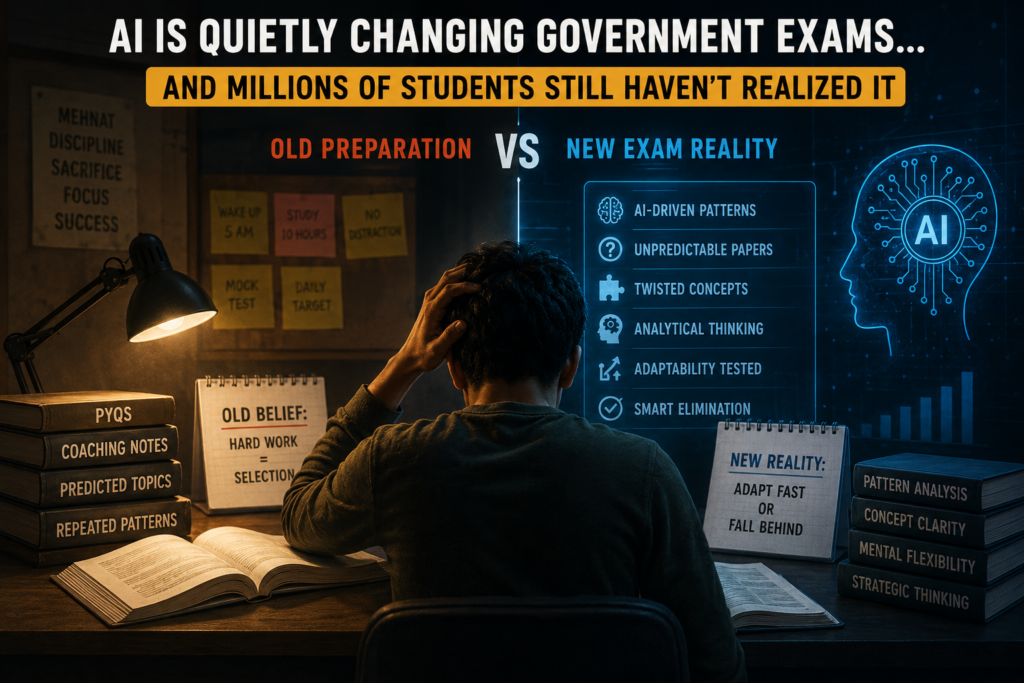
Today’s papers increasingly contain:
- twisted concepts,
- analytical framing,
- mixed-topic logic,
- unexpected combinations,
- elimination traps,
- and psychologically confusing questions.
Students prepare for one style…
but the actual exam suddenly tests another.
This is why many aspirants now feel:
“Paper padh ke hi dimaag blank ho gaya.”
Not because they didn’t study.
But because:
The exam pattern evolved faster than their preparation strategy.
The Real Problem Nobody Talks About
Most students are still preparing with:
- old methods,
- rote learning,
- repetitive revision,
- and predictable expectations.
But modern exams are increasingly designed to break predictable preparation patterns.
That is the biggest shift.
Today’s competition is no longer only about:
“Who studied more?”
Now it is also about:
“Who adapted faster?”
Why Hardworking Students Are Feeling More Pressure
There are thousands of students who:
- genuinely work hard,
- study honestly for years,
- avoid distractions,
- stay disciplined,
- and still fail repeatedly.
This category is increasing.
And many students silently feel:
“Maybe hard work alone is no longer enough.”
That feeling is painful…
but partly true in today’s changing ecosystem.
Because modern exams now reward:
- adaptability,
- analytical thinking,
- pattern recognition,
- mental flexibility,
- and smart strategy.
Not just long study hours.
AI Has Increased One Dangerous Thing:
Uncertainty
Earlier students feared:
- tough competition,
- limited seats,
- or syllabus size.
Now students fear something else:
“Paper kis pattern ka aa jayega?”
And that uncertainty changes everything.
Even brilliant students panic when:
- the paper structure suddenly changes,
- familiar patterns disappear,
- or expected preparation becomes useless.
The Biggest Mistake Aspirants Make Today
Many students still believe:
“More hours = guaranteed selection.”
But in modern competitive exams:
10 smart analytical hours can defeat 16 directionless hours.
Because today’s exams increasingly test:
- thinking speed,
- decision-making,
- mental stability,
- adaptability,
- and intelligent elimination skills.
Not just memory power.
The Harsh Reality of the AI Era
Artificial Intelligence is quietly creating a new divide between students.
One side:
Students using old preparation systems.
Other side:
Students adapting to changing intelligent exam patterns.
And the gap between these two groups is increasing every year.
What Students Need To Understand Now
The future of competitive exams will likely become:
- more dynamic,
- more unpredictable,
- more analytical,
- and more intelligence-oriented.
Students who only memorize may struggle more.
Students who:
- understand concepts deeply,
- adapt quickly,
- analyze patterns smartly,
- and train their minds for uncertainty
will survive better.
Final Truth
AI may not directly write every government exam paper.
But AI-driven systems, analytics, and modern data-based design methods are clearly changing:
- how papers are structured,
- how difficulty is balanced,
- and how students are filtered.
That is why many hardworking aspirants now feel:
“Preparation purani thi… but exam system naya ho gaya.”
And honestly?
That conversation needs to happen openly before another generation of students keeps blaming themselves for a system that has already evolved.