Actual Meaning of Chapter 13 of the Bhagavad Gita
Chapter 13 of the Bhagavad Gita is called Kshetra Kshetrajna Vibhaga Yoga — the Yoga of Distinguishing the Field and the Knower of the Field.
In this chapter, Lord Krishna explains one of the deepest concepts of human life:
the difference between the body, mind, and the true self.
Krishna describes the human body and mind as the “Kshetra” (Field) — the place where thoughts, emotions, desires, fears, actions, and experiences happen.
But beyond this field exists the “Kshetrajna” (Knower of the Field) — the conscious self that observes all these experiences.
In simple words, Krishna teaches that:
- the body changes
- thoughts change
- emotions change
- desires change
- situations change
But the deeper consciousness observing these changes remains beyond them.
This chapter focuses on:
- self-awareness
- consciousness
- inner observation
- wisdom
- understanding human nature
Krishna also explains that true knowledge is not only external learning.
Real wisdom comes from understanding:
- who we truly are
- how the mind works
- how attachment and ego influence life
- and how awareness leads to clarity
This is the real essence of Chapter 13.
How Chapter 13 Connects with Modern Technology and Digital Life
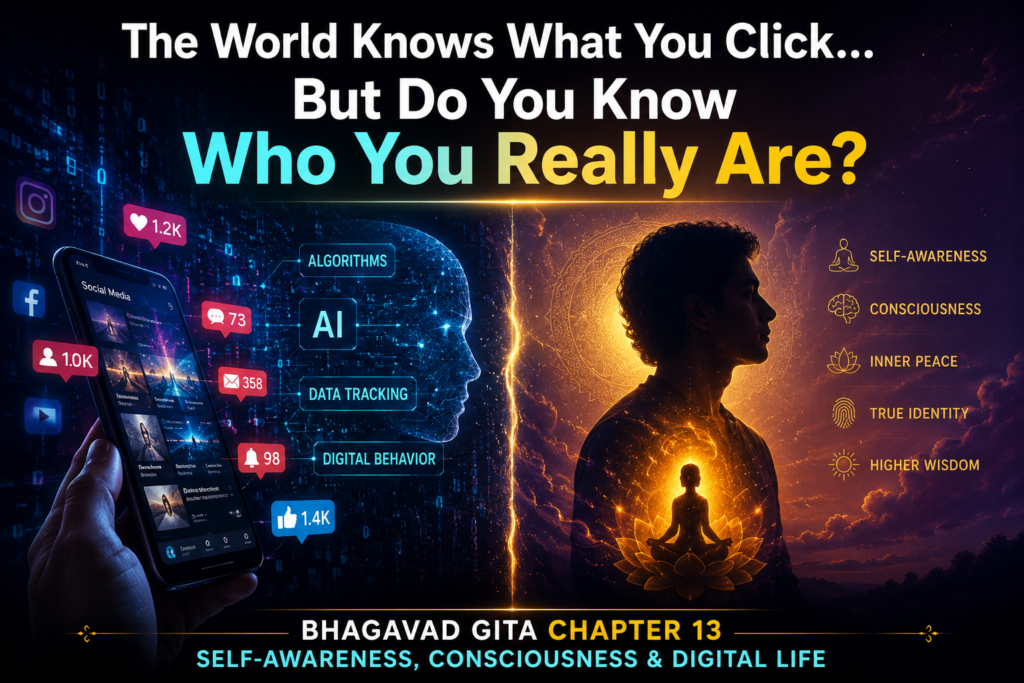
The message of Chapter 13 feels incredibly relevant in today’s digital world.
Modern technology constantly pulls human attention outward.
People spend hours every day consuming:
- social media
- entertainment
- notifications
- online opinions
- digital content
As a result, many people become deeply connected to external stimulation but disconnected from their inner awareness.
This is where the wisdom of Chapter 13 becomes powerful.
Today, people often identify themselves completely with:
- online identity
- appearance
- followers
- achievements
- public image
- digital validation
But Krishna’s teaching reminds us that human identity is deeper than external labels and temporary experiences.
Social media constantly changes how people feel.
One comment can create happiness.
One comparison can create insecurity.
One failure can affect confidence.
Why?
Because many people become emotionally attached to what happens in the “field” — the external world of reactions, appearances, and experiences.
Chapter 13 teaches something deeply important:
We should observe thoughts and emotions instead of becoming completely controlled by them.
This idea has become extremely relevant in the digital age.
Today, many individuals constantly react emotionally to:
- online opinions
- comparison
- criticism
- trends
- validation
As a result, mental peace becomes unstable.
Technology itself is not the problem.
The deeper challenge is loss of self-awareness.
Modern digital culture trains people to continuously observe the outside world—
but rarely themselves.
People know:
- what others are doing
- what is trending
- what is viral
- what others think
But many still struggle to understand:
- their own emotions
- fears
- anxiety
- habits
- mental patterns
This is why Chapter 13 is one of the most psychologically relevant chapters of the Bhagavad Gita today.
Krishna explains that true wisdom begins when a person becomes aware of the difference between:
- temporary mental experiences
and - deeper consciousness
This awareness creates emotional clarity.
Without self-awareness, people become emotionally controlled by external events.
And modern technology amplifies this problem because digital platforms are designed to constantly influence attention, emotions, and reactions.
That is why many people today feel:
- mentally overloaded
- emotionally restless
- constantly distracted
- dependent on external stimulation
Even while having unlimited information available online.
This is the hidden crisis of the digital age:
people are becoming more connected externally but less aware internally.
And perhaps this is the most important lesson Chapter 13 offers today:
True intelligence is not just understanding technology or the world outside.
True intelligence also means understanding the mind within.
In the end, Chapter 13 reminds us that peace begins when people stop losing themselves completely in external noise and reconnect with deeper self-awareness.
That timeless wisdom may be more important today than ever before.